Saturday, March 30, 2013

Banach-Tarski Paradox II

This is the second post concerning the Banach-Tarski paradox. For the first, see here.

The Banach-Tarski paradox allows one to, through decomposition and reassembly, turn one three-dimensional ball into two without changing the individual pieces, apparently violating the additivity of volume in Euclidean three-dimensional space. In the previous post, a decomposition of the group F2, roughly the set of finite strings of the symbols "a" and "b", was shown to yield two copies of the same group when the pieces were "translated" in a certain sense.

In carrying over the properties of F2 into three-dimensional space, one treats the symbols a and b as rotations about axes in Euclidean three-dimensional space. Traditionally, the axes are considered to be the x- and z-axes of Cartesian coordinates. In fact, the necessity of a choice of axes is why a paradoxical decomposition can only occur in dimensions of three and above, and not in two. This is because, in F2, the strings ab and ba are distinct; following their respective paths on the Cayley graph yields two different points. In two dimensions, any two rotations about the origin are commutative, i.e. can be performed in either order with the same result. Since the noncommutativity of F2 cannot be carried over into two-dimensional space, the paradox is not possible there.

The rotations that correspond to a and b are taken to move through an angle of the inverse cosine of 1/3, or about 70.5°. This exact angle choice is unnecessary, but the angles chosen for a and b must be irrational multiples of a right angle. This is because no two linear combinations of them can be allowed to yield the same rotation; all linear combinations of the angles must be distinct. The purpose of this condition is to mimic a property of the group F2, namely that no two distinct simplified strings represent the same element, or, in other words, no two distinct paths (without retracing) lead to the same point on the Cayley graph.

Next, we briefly restrict our attention to the sphere (which, unlike the ball, does not include the interior area; the sphere is as the surface of the earth and the ball like the surface as well as the interior). The set F2, which we shall now consider a group of rotations, can act on any point p of the sphere. The set of points thus obtained, following any sequence of rotations (each corresponding to an element of F2) beginning at p, is called the orbit of p.

In this way, the entire surface of the sphere can be partitioned into an infinite set of these orbits, none of which overlap. Since a set of finite sequences is countable, F2 is as well. Since the number of points on the sphere is uncountably infinite, it follows that there are uncountably many of these orbits. Here the axiom of choice is invoked to select a single point from each orbit, and collect these into another set M.

The details involved in explicitly applying the decomposition of the sphere are too technical to consider here; the above steps were included to illustrate the use of the axiom of choice. The next step essentially brings about the paradoxical decomposition of the sphere by shifting M by the rotations a and b. Two copies of the sphere arise in a manner similar to that of F2.

Finally, the result is extended to the three-dimensional ball by performing the decomposition on a continuum of spheres of radii 0<r<R, where R is the original radius of the ball being considered. Each point p on the outer sphere can be paired to a point on any of the smaller spheres by projecting inward along the ray from p to the origin (see below). Clearly the union of all these spheres contains all the points of the ball, with the exception of the origin, O.


The final obstacle, therefore, is proving that the ball with its center removed can be decomposed and reassembled to form the entire ball. In fact, there are subtle difficulties in doing this that do not concern us here. Once this is done, the Banach-Tarski theorem is proven.

Following this technical formulation, it is enlightening to step back and consider the implications of the paradox. It is important to see that the decomposition above could not be applied to a physical object. The above procedure depends on the infinite divisibility of the ball, which an object composed of matter does not possess. Additionally, the pieces in the decomposition, though finite in number, are not "chunks" of the ball but infinite collections of points, and so are not physically continuous.

Though inapplicable to the physical world, the Banach-Tarski paradox helps to elucidate the fundamental differences between mathematical and physical space, and the wide-reaching consequences of assuming statements such as the axiom of choice.

In response to this and similar paradoxes that follow from the axiom of choice, there have been attempts to appropriately weaken the axiom of choice to an axiom which, though giving most of the same benefits, eliminates the paradoxes. One of these is called the axiom of countable choice, which limits the applicability of the axiom to countable sets. This avoids the Banach-Tarski paradox, but some set theoretical results are lost. In addition, the rather arbitrary restriction to countable sets seems inelegant, as it complicates the axiom, bringing in more concepts.

Also, some interesting work has been done since the Banach-Tarski paradox was published in 1924 that has extended the result. First, the final step of the proof above, in its original form, involved a total of 24 pieces. Through an alteration of the orbit scheme above, the number of pieces can be reduced to five.

Furthermore, the beginning and ending sets can be more general than simply a ball and two balls. Clearly, by a repetition of the above process, any (finite) number of balls can be produced by decomposition. It has even been shown that, if the original ball can be decomposed into an infinite number of pieces, one can obtain infinitely many copies of the ball, and even uncountably many. By allowing these decompositions, we can simply conjure up as many balls as we want from a single one!

In fact, the statement has been generalized even further to allow any bounded three-dimensional regions which are not "empty" to be broken up into a finite number of pieces and reassembled into any other of these regions.

The Banach-Tarski paradox is central in proving that there is no finitely additive measure in three-dimensional (and higher) spaces which agrees with the basic conception of volume. In one and two dimensions, there still is no countably additive measure that can be universally applied due to the existence of non-measurable sets (see again the Lebesgue measure series for an example of a measure in mathematics). The above are a few of the surprising geometric applications of the axiom of choice, showing how pervasive this assumption is, even beyond its native set theory.
Sources: http://www.math.hmc.edu/~su/papers.dir/banachtarski.pdf, http://www.bsu.edu/libraries/virtualpress/mathexchange/05-01/Coleman.pdf, Banach-Tarski Paradox at Wikipedia

Friday, March 22, 2013

Banach-Tarski Paradox

The Banach-Tarski paradox is a very counterintuitive theorem in geometry that, in effect, states that a three-dimensional ball can be broken up and reassembled in such a way that two identical balls of the same size as the first are formed. This "doubling" of the ball seems contrary to the usual ideas of Euclidean geometry, and is therefore exemplifies the controversy over its underlying assumption, the axiom of choice.

The axiom of choice is one of the most debated topics in mathematics. It is an axiom of set theory, and the debate is whether it is right to assume it, and in what "strength" or version. The axiom itself, put informally, runs thus:

From any collection of nonempty sets, there exists a way to choose exactly one member from each set.

The ability to make such choice seems intuitive enough, but as seen elsewhere on this blog, the assumption of the axiom of choice implies the existence of sets that have no "volume", i.e. their size cannot be measured in any way. And this, as we shall see, is a crucial concept needed to derive the Banach-Tarski paradox.

The "translation" of the paradox into set theoretical concepts involves treating the three-dimensional ball as a set, call it A. We consider a division of the ball as a partition of the set A into the subsets A1, A2,...,An, where none of the subsets overlap, or in set notation, where AiAj = Ø whenever ij (i and j run from 1 to n). In this decomposition, n is finite, and only a finite number of pieces are needed to transform one ball into two. This in itself makes the paradox even more unbelievable.

After the ball is partitioned, each piece would then undergo a translation (some movement in space) and a rotation, taking each subset Ai to a corresponding Bi. In this translation, the intrinsic properties of the subsets are not altered; they are simply rearranged in space. The resulting sets, B1,...,Bn, can be split into two groups in such a way that B1B2∪...∪Bm is a ball congruent to the first, and the union of remaining subsets, Bm + 1∪...∪Bn, is another ball also congruent to the original one. The transformation is illustrated below:


Since Euclidean translations and rotations preserve volume, the Banach-Tarski paradox violates the principle of the additivity of volume, i.e., that the sum of the volumes of two disjoint sets is the volume of their unions. The beginning ball and the (union of) two equivalent balls are composed of the same (translated) pieces, but they have different volumes. The reason this principle is violated is that the sets in question are non-measurable, or cannot be assigned a volume by any measure. Therefore, the idea of volume additivity has no meaning for them. Non-measurable sets, in addition, can only be proved to exist with the axiom of choice or an equivalent statement. We shall assume the existence of these non-measurable sets, but a construction of such a set under the Lebesgue measure can be found here.

The proof of the Banach-Tarski paradox at first does not work directly with the ball, but instead deals with a more abstract group of points. As we shall see, the decomposition of this abstract set can be performed analogously on the ball with slight modifications.

The abstract set in question is called the free group of two generators, or F2, and it refers, in effect, to the set of strings of the symbols a and b, as well as their inverses, a-1 and b-1. For example, the strings aba-1b and bba-1baa are members of F2. We also define e, or the empty string, as the string in F2 with no members. Finally, we define an operation, *, on strings in F2 that combines two strings into one by placing the second directly after the first. Therefore ab-1*b-1aab = ab-1b-1aab. Additionally, strings are simplified by two rules, where x stands for any string in F2:
  1. ex = xe = x
  2. aa-1 = a-1a = bb-1 = b-1b = e
As an example of the above rules, consider the product (under the operation *) of the strings a-1bab and b-1a-1bab-1.

a-1bab*b-1a-1bab-1 = a-1babb-1a-1bab-1 = a-1baea-1bab-1 = a-1baa-1bab-1 = a-1bebab-1 = a-1bbab-1

The group F2 can be visualized in several ways. One is as an infinite "tree" of elements, where points on the tree represent strings and "branches" describe the construction of these strings. Below is one example of such a visualization.


A tree of this type is called a Cayley graph of the group F2. Illustrated are the strings of F2 up to three symbols in length. The segments connecting the strings (black dots) illustrate the addition of a symbol to the right of the existing string. One begins in the center with e, the empty string, and moves right to add an "a" and up to add a "b". Moving oppositely to either of the above directions appends an inverse of the corresponding symbol. Note that tracing a path and then retracing backward produces a symbol adjacent to its inverse, causing cancellation. The construction of the string ba-1b-1 is illustrated; staring at e, one first proceeds upward, then left, then down. The reader can verify this construction.

The decomposition of F2 requires the use of some new notation. By S(a) denote the set of all strings in F2 beginning with the symbol a. Define the expression similarly in the case that a-1, b, and b-1, respectively, are substituted for a. Next, the notation, aS(a-1), for example, refers to the set of strings produced by joining the string "a", with a member of the set S(a-1). Thus there is a string in aS(a) for every string in S(a). It must be made clear, however, that the set S(a) and the other related sets contain only simplified strings. Nowhere in any string in S(a) will there appear a term "aa-1" or "bb-1", as these will have already been cancelled.

Armed with these notions, we can construct the "paradoxical" decomposition of F2. The first step is a simple decomposition involving separating the group into each of four disjoint quadrants, the sets S(a), S(a-1), S(b), and S(b-1), and the set {e}, consisting only of the empty string.

The next operation required is a "shift" of the set S(a-1) by the element a into the set aS(a-1), which, as discussed above, has as members every string obtained by adjoining a, (through the operation *) on the left, to some member of S(a-1). The significance of this shift in relation to the sphere will be apparent later. This shifted set is interesting because, when a is combined with a string beginning with a-1, the two elements cancel. Since, in S(a-1), the second and subsequent symbols of each member are arbitrary, every string beginning with a-1, b, or b-1 is a member of aS(a-1). For example, the string bab-1 is the same as a combined with a-1bab-1, a member of S(a-1). Also, strings beginning with a-1 such as a-1bb can be formed as the combination of a and a suitable string beginning with "a-1a-1", in this case a-1a-1bb. Finally, since a-1 is obviously a member of S(a-1), the string aa-1 = e is therefore a member of aS(a-1). In fact, the only strings that are not included in aS(a-1) (ironically) are those beginning with a! This is because, for this to occur, the second element of a member of S(a-1) would have to be a, and this cannot occur, as all strings in S(a-1) are assumed to be simplified.


The above is another view of the Cayley graph, this time illustrating the quadrant S(a-1) along with the shifted set aS(a-1). The only strings not members of the latter set belong to S(a). Therefore, the group F2 is a union of aS(a-1) and S(a). A similar procedure, substituting b for a, leads to the conclusion that the union of bS(b-1) and S(b) is again F2. In summary,

F2 = {e}∪S(a)∪S(a-1)∪ S(b)∪S(b-1) = aS(a-1)∪S(a) = bS(b-1)∪S(b).

The sets S(a-1) and S(b-1) from the original have been shifted by a and b, respectively, and been incorporated into two other decompositions of the same group F2. One copy of F2 has been made into two. (One might well wonder "what happened to {e}?" It turns out that this piece is simply discarded in the above procedure, but the scheme is modified slightly in application to the ball to correct this subtlety).

The relation between F2 and the three-dimensional ball, as well as other extensions of the paradox, are found in another post.

Sources: http://www.kuro5hin.org/story/2003/5/23/134430/275, Banach-Tarski Paradox on Wikipedia

Thursday, March 14, 2013

Lebesgue Measure III

For an introduction to the Lebesgue measure and various applications to sets in Rn, see the previous two posts, beginning here.

The utility of the Lebesgue Measure has been described in the previous two posts. To briefly summarize, the Lebesgue measure provides a more general notion of the "size" of a set in space that matches up with the intuitive notions of length, area and volume in 1, 2, and 3 dimensions, respectively, as well as preserving natural properties such as the volume of a union of disjoint sets being the sum of volumes of the individual sets. It even goes beyond these notions to measure countable and uncountable sets, manifolds, and even fractals of various sorts. However, under certain assumptions, there exist sets which cannot be consistently assigned a Lebesgue Measure. Such sets and the validity of the underlying assumption necessary for their existence are discussed in this post.

For the construction of these Lebesgue non-measurable sets or Vitali Sets, one must assume one of the most dubious and controversial statements in mathematics: the axiom of choice.

The axiom of choice is not by any means specific to measure theory, but rather is an axiom of set theory, and therefore lies at the foundation of mathematics. The axiom, put informally, is the seemingly innocent statement below:

For any family of sets, there exists a way of choosing (hence the name "axiom of choice") one member from each set in the family.

Slightly more formally, it states that for any set X containing only nonempty sets as members, there exists a choice function f which selects exactly one member from each member of X. Of course, there may be many choice functions for a collection X of sets; the axiom simply guarantees that at least one exists. For example, set
X = {x1,x2,x3} = {{4,5,6},{1,4,7},{2,7,9}}. A choice function on this collection of sets maps each subset of X to one of its members. For example, one could have
f(x1) = f({4,5,6}) = 4, and the function would be similarly defined on x2 and x3.

The act of selecting one member from each of a class of sets seems completely natural and perhaps even fundamental. It seems impossible to imagine a collection of sets where such a choice function would not be possible. Yet the axiom of choice implies the existence of a set that is not measurable by the Lebesgue Measure, and therefore has no definable volume. That such a set exists and can be embedded in a "well-behaved" space like Rn seems surprising, almost contradictory. Without further ado, let us construct a Vitali Set.

For simplicity, the Vitali Set considered will be in R1. The first step in constructing a Vitali Set relies on a concept called a quotient group, specifically the quotient of the real numbers and the rational numbers, denoted R/Q.

R/Q contains a number of classes. Each class is the set of rational numbers Q shifted by a real number r. More specifically, each class, denoted Q + r, contains every number that is formed by adding a rational number to r. For example, if r is π, a real number, then Q + π contains members such as 3/4 + π and -9 + π, but not multiples of π such as π/2, nor rational numbers themselves (e.g. 1/2). Conversely, a real number x is a member of Q + r if and only if x - r is rational. Finally, to form the quotient group R/Q, we discard any "repeats", so that each pair of classes Q + r and Q + s in R/Q is disjoint, i.e. the two have no common elements.

Since the real numbers form an uncountable set, but each class Q + r has as many members as the rational numbers and is countable, the quotient group R/Q is an uncountable set, containing countable sets as members. It is also a partition of R, as every real number is contained within one of the classes, but only one, as they are disjoint.

The next step in construction makes use of the axiom of choice. Clearly, each class
Q + r contains members in the interval [0,1] (as each is dense in the real numbers). Therefore, for each class Q + r, the set (Q + r)∩([0,1]) (∩ denotes the intersection of two sets) is nonempty. The axiom of choice then allows one to select exactly one member from each (Q + r)∩([0,1]), and combine them into their own set. The resulting set has one member for each class of R/Q, all within the interval [0,1].

Call the set just formed V. Note that V was not determined in any precise sense, and rather could be any one of an infinity of possible sets satisfying the same conditions, but for a different selection of choice functions. Furthermore, V is uncountable, and for every real number r, there is exactly one vV such that v - r is rational. Also, taking r = 0, there is exactly one rational number in V.

V is the Vitali set. Now it must be proven that it does not have a Lebesgue measure. The final step involves translations of V itself, formed in a manner analogous to those of the classes of R/Q. This time, however, the shifts will be of certain rational numbers.

Since the rational numbers are countable, we can make use of a "catalog" of them, indexed by the positive integers. In other words, we can list the rational numbers, and assign every one a number which will serve as its index. This is called an enumeration of the rational numbers. The enumeration, in this case, will be confined to the rational numbers in the interval [-1,1]. As with the selection of choice functions, the enumeration of these numbers chosen is arbitrary, as differences between specific enumerations will not affect the final result. Denote each rational number in the list qi, for a positive integer i. For example, one could have q1 = 0, q2 = 1/2, q3 = -2/5, etc..

Now we form, for each qi, the set Vi = V + qi, or the set of all numbers created by adding qi to a member of V. It is very important to note that the resulting sets are pairwise disjoint; no two of the translations contain a common member. To see this, remember that each member v of V is representative of a class of the form Q + r. There is one, and only one member of V for every class of the above form in R/Q. The corresponding member in each Vi will also be a member of the class Q + r, as it differs from v only by a rational number. Therefore, it cannot be the same as any member of any Vi formed from another class Q + s. Finally, since the qi are distinct, no two translations of the member v of the original V yield the same number.

After this fact is accepted, the non-measurability of V can be proven. The set that must next be considered is actually the union of of all the Vi. Since there are countably many Vi, and they are pairwise disjoint, the Lebesgue measure of the union is the sum of the Lebesgue measures of each Vi. Hence,


What is the value of this sum? We can place some limitations on it by an examination of the union of the Vi. Note first that every real number on the interval [0,1] is contained within the union of the Vi, since the original V contains representative members of each class in a partition of R/Q. Since these representative elements are within [0,1], it is only necessary to shift them by a number such that |q| ≤ 1, because a distance of 1 is the "farthest away" two objects in [0,1] can be from one another. This reveals the purpose of the enumeration only being of the rational numbers between -1 and 1. Shifting a single element v of V that represented the class Q + r by all of the qi (which lie in the interval [-1,1]) will recreate all of Q + r in [0,1], as well as more outside the interval.

The logical basis for the second limitation is even simpler. Since each v in V must be within [0,1], and the maximum shift induced by the qi to form the Vi has a magnitude of 1, all members of the union of the Vi must be within [-1,2]. More precisely, the smallest possible member of V is 0, causing the smallest possible member of the Vi to be -1, and the largest possible member of V is 1, causing the largest possible member of the Vi to be 2. The above limitations are illustrated in equation below:


We can now use the simple property of the Lebesgue measure that if a set A is contained within another set B, then λ(A) ≤ λ(B). Substituting inequality for inclusion, we can then replace the sets in the above equation with their measures:


Note, finally, that a translation of a set has the same measure as the original set. This is a basic property of the Lebesgue measure, and is reflected in one's intuitive notion of Euclidean geometry; moving figures around in the plane, for example, does not change their area. In light of this property, since each Vi is a translation of V, the last inequality becomes


However, this is a contradiction. Since the expression in the infinite sum is independent of i, it is simply a constant added to itself an infinite number of times. However, the Lebesgue measure of a set can only be a positive real number or zero, and neither of these, when added to itself an infinite number of times, can produce a number between 1 and 3. The assumption that V is measurable is therefore false.

V is not unique of course, due to the different choice function possibilities. In fact, uncountably many Vitali sets arise from the above construction. The idea that so many sets on such a simple structure as the real number line could be non-measurable is remarkable. This brings us back to the main question: is the axiom of choice valid?

There is little consensus on this topic among mathematicians. The axiom itself (in its set-theoretical form) seems intuitive but there are many equivalent or implied statements that seem counterintuitive, such as the result above. Non-measurable sets have been applied to formulate a statement that seems so blatantly contradictory that it is called the Banach-Tarski paradox. It states that, given the axiom of choice, one can subdivide a three-dimensional ball into discrete pieces, and, without altering them, rearrange them in such a way that two three-dimensional balls are formed of identical size to the first. Such an act of "cloning" in reality is contrary to common physical principles. Yet mathematically, many important and seemingly valid theorems depend on the axiom. Therefore, there is evidence for both arguments, and the matter is not likely to be conclusively resolved in the near future.

Returning briefly to the Lebesgue measure, the effectiveness and generality of this instrument, despite the above defect, has led to growth in many related areas of mathematics. Lebesgue himself used the measure and related concepts to more rigorously define properties of functions on Rn, including those which, in earlier periods, were often disregarded. Since the theory of measure is related to that of manifolds, the above developments had great significance in the area of topology as well.

Sources: Vitali Sets, Axiom of Choice on Wikipedia, http://homepage.univie.ac.at/erhard.reschenhofer/pdf/probstat/P_A.pdf

Wednesday, March 6, 2013

Lebesgue Measure II

For the definition of the Lebesgue Measure and some of its simple applications to sets, see the previous post.

So far, many of the sets discussed have been products of non-degenerate intervals (or sets approximated by these products of intervals), and these have had positive Lebesgue Measures. Since an interval in R1 is an uncountable set, so are the products of intervals in Rn. The other sets that have been considered have been either finite or countable, and all of these have had Lebesgue Measure 0. Therefore, thus far, negligibility has coincided with countability. However, there are also uncountable sets which are negligible.

The key concept is that a subset A of Rn is negligible if it has a dimension less than n. Before exploring the implications of this statement, consider a simple example:

Let the set A be interval [0,1] embedded in R2 (illustrated below). This, being an interval, is an uncountable set, but it can be shown by a succession of approximations by squares in R2 that this set has Lebesgue Measure 0.


A portrayal of the set A in R2. The standard Cartesian coordinates and axes are superimposed for clarity. The first approximation (top), uses the single square (2-prism) [0,1]x[0,1], which clearly contains A, to approximate the volume of A. Having side length 1, the volume is 1. In the second approximation (middle), the union of two squares, J21 and J22, each with side length 1/2, clearly contains A, the total volume of the approximation (denoted by J2) being (1/2)2 + (1/2)2 = 1/2. The third approximation (bottom), follows a similar approach, with four squares of side length 1/4 containing A and yielding the approximation J3 = 1/4 to A. Clearly, if the side length of the approximating squares is halved in each successive approximation, the resulting estimated volume is halved each time. Since this can be done indefinitely, λ(A) = 0.

The above example shows how squares, the most basic units of area in R2, can be used to calculate the volumes of other sets, including negligible ones. This example also motivates a useful condition for negligibility: A set S is negligible in Rn if, for every ε > 0, no matter how small, there exists a (finite) collection of rectangular n-prisms Ji, such that S is contained within the union of the Ji and the Lebesgue measure of the union of the Ji is less than or equal to ε.

Since the set A in the example is one-dimensional (in our as yet intuitive sense), its negligibility is consistent with the previous statement that a set of some dimension embedded in a real space of higher dimension is negligible, as 1 < 2. Note that, if the same set A were being considered as a subset of R1, it would not be negligible, but rather λ(A) would equal 1. This reveals the importance of specifying the dimension of the ambient space Rn. More generally, if A is a "well-behaved" manifold of dimension m embedded within Rn, and m < n, then A is negligible under the Lebesgue Measure.

The purpose of the qualifier "well-behaved" is to distinguish between two types of dimension. The common idea of dimension, the number of perpendicular directions one can "contain" in space, is what is called the topological dimension. However, the Lebesgue Measure also depends on something called the Hausdorff dimension, named after the German mathematician Felix Hausdorff. This alternate measure of dimension applies to a larger class of sets, notably fractals, and does not assign only integer values; many sets have Hausdorff dimension between 1 and 2, for example.

For any space, the Hausdorff dimension of the space is always greater than or equal to the topological dimension (if applicable) of the same space. Thus, even if a set topologically has a smaller dimension than the real space around it, it may still have nonzero Lebesgue Measure.

Take, for example, the Cantor Set. It is produced by removing the middle third of the interval [0,1], and, on every subsequent step, removing the middle third from each remaining line segment. After an infinite number of steps, the set remains. The properties of this set are proved elsewhere. The Cantor set is a fractal, an uncountable set, but not a dense set. Also, if its points are expressed in ternary (base 3) notation, the numerical expansion of each member of the set contains only 0's and 2's (in base 3, the possible digits are 0, 1, and 2). The Hausdorff dimension of the Cantor set is related to its property of containing points which "use" only 2 out of the 3 digits of the ternary system; the dimension is ln(2)/ln(3) ≈ .6309. This figure gives some idea to "how big" the set is. Since this is less than 1, the dimension of the real space in which it is embedded, the Cantor Set has Lebesgue Measure 0.

In the above case, the topological dimension can be considered to be 0, as the set contains only "isolated" points. However, the Hausdorff dimension, though greater, was still less than that of the ambient space, giving the same result: the Cantor set is negligible. In other cases, the distinctness of the Hausdorff dimension does affect the Lebesgue Measure. Consider the figure below.


The above illustrates three stages of the construction of a fractal known as a space-filling curve, or Peano curve. It is a fractal because it is self-similar (structures are duplicated on smaller levels in each step), and after infinite steps, it fills every point in the space it occupies, which, for simplicity, we will assume to be the unit square [0,1]x[0,1] in R2. Locally, each part of the space-filling curve looks like a line, giving the set topological dimension 1. However, it fills every point in a two-dimensional region, and has Hausdorff dimension 2. With respect to the Lebesgue Measure on R2, the space-filling curve is not a negligible set, but rather has a positive Lebesgue Measure, equal in magnitude to the volume of the unit square, that is, 1.

This post has illustrated the application of the Lebesgue Measure to an even wider variety of sets. However, there are some even more exceptional sets to which the Lebesgue Measure does not assign a value at all! (see the next post)
Sources: Advanced Calculus of Several Variables by C.H. Edwards Jr., Vitali Sets on Wikipedia

Tuesday, February 26, 2013

Lebesgue Measure

The idea of a "measure", intuitively a rule that determines the size of an object, is very important to mathematics. It is used as a baseline for comparing mathematical "objects", usually sets. However, what consistent way is there to assign sizes to sets that varies over such the wide variety of sets found in mathematics?

One approach is called the Lebesgue measure, named after the mathematician Henri Lebesgue, who introduced the concept around 1902. With this measure, the size of a set A is denoted λ(A). The "objects" or sets that can be measured are considered to reside within the a real Euclidean space Rn for some positive integer n. For each dimension n, Rn is the typical flat (Euclidean) space. For n = 1, it is the line, n = 2, the plane, etc. An intuitively easy way to deal with many sets in real space is simply to measure their volumes. For such sets where this is easily done, the Lebesgue measure coincides with what we traditionally calculate as "volume".

The basis for area in n dimensions is found in one dimension, where "volume" is simply length. To a closed interval [a,b] in R1 (the set of real numbers from a to b, including a and b, see below), the Lebesgue measure assigns the value b - a.


In more than one dimension, we define the Cartesian product of two closed intervals [a,b] and [c,d] in R1 as the rectangle in R2 bounded by the lines x = a, x = b, y = c, and y = d. Its volume, as per the usual practice, is the product of the lengths of the respective intervals; in this case, it is (b - a)(d - c). In equation form, with the Cartesian product indicated by x, λ([a,b]x[c,d]) = (b - a)(d - c).


This approach is extended to three dimensions by considering the Cartesian product of 3 (non-degenerate) closed intervals, which takes the form of a rectangular prism, the volume of this set being the length times the width times the height, as is normal. In n-dimensions, the Cartesian product of n closed intervals I1, I2,..., In forms an n-dimension rectangular prism with volume |I1|·|I2|·...·|In|, where |Ii| is the length of the respective interval.

This rectangular prisms in n-dimensions, or rectangular n-prisms, are the building blocks of volume in Rn. Another basic property of the Lebesgue measure is that, if two sets A and B are disjoint, i.e. do not overlap, or more formally, their intersection is empty, then λ(AB) = λ(A) + λ(B). This expression holds as long as the measures are defined. More generally, if n disjoint measurable sets are involved:


This formula simply states that the volume of the union of the sets is the sum of their individual volumes. Remarkably, this even applies to infinite unions of sets, as long as the number of sets is countable, or, equivalently, if the collection of sets can be put into a one-to-one correspondence with the natural numbers (for more, see here).

To define volume for a more general set, one approximates the set as an addition of smaller sets, usually n-prisms. To be more precise, for a set A, if a set of disjoint rectangular n-prisms are contained completely within A, then the sum of their volumes is an lower approximation to the volume of A. If a set of rectangular n-prisms (not necessarily disjoint, i.e. there could be some overlap) completely covers the set A in Rn, then it serves as an upper approximation to the volume of A. This method of finding area is called integration.


An illustration of how rectangular n-prisms can provide upper and lower approximation to the volume of a more general set A.

Another property of the Lebesgue measure is invariance under translation and rotation. In other words, if a set A is rotated or moved around in Rn to another set B, then λ(A) = λ(B). On the other hand, if a set is dilated, or expanded, by a factor d, where d is a positive real number, and the dilated set is denoted dA, then

λ(dA) = dnλ(A),

where n is the dimension of the ambient space (Rn).

Now, one can consider various sets in Rn and their Lebesgue measures. First, any point, or more precisely, the set containing a single point P, {P}, has measure 0. This is because it can be viewed as a product of intervals each with length zero. Now, any finite set, that is, including a finite number of points, has Lebesgue measure 0, as such a set can be expressed as the union of many sets, each containing one point, which we known to have measure 0. A set with measure 0 is called negligible.

Similarly, the set of integers, or, for higher dimensions, the set of ordered n-tuplets of the form (a1,a2,...,an) where the ai are integers, is negligible, as these sets are countable (this is proven here).

Returning to R1, the set Q of rational numbers, or those numbers expressible as a quotient of two integers, is countable, and therefore negligible, with λ(Q) = 0. This is the first example of a dense set that is negligible. The higher dimension analog of the rational numbers in R1 is, for each dimension n, the set of n-tuplets (a1,a2,...,an) where the ai are rational numbers. For every n, this set is negligible, with Lebesgue measure 0.

However, the Lebesgue Measure does far more than distinguish between countable and uncountable sets. More properties and measures of sets are presented in the next post.
Sources: Advanced Calculus of Several Variables by C.H. Edwards Jr., Lebesgue Measure on Wikipedia

Monday, February 18, 2013

Degenerate Matter: Black Holes

This post concerns black holes in the context of degenerate matter. For an introduction to degenerate matter, followed by a description the various stages of a stellar remnant's collapse preceding the possible formation of a black hole, see here.

White dwarfs, neutron stars, and hypothetical exotic stars are examples of objects of various masses within which some force counteracts gravity and stops collapsed stellar cores from shrinking further. However, above about 3.5-4 solar masses, no known force can counteract gravity. The collapsed star shrinks even further, until its escape velocity, the velocity necessary to leave the object from its surface, reaches the speed of light. At this stage, nothing can escape the body, not even the fastest particles in the Universe: photons. The collapsed star has become a black hole.

As far as is known, no further phenomenon can halt the contraction of the stellar remnant. Under its own weight, the black hole would collapse to become infinitely small and infinitely dense: such an object is called a singularity. Such singularities are consistent with the theory of relativity, but it is not known whether a singularity would be compatible with quantum mechanics; an infinitely dense object seems contrary to any known particle behavior.

Despite the complexities of black hole formation, the structure of a black hole is very simple. In some ways, as we shall see, it is even too simple. From long distances away, a black hole exerts gravity just the same as any other object. For example, light near a black hole undergoes gravitational lensing just as light around neutron stars does (see below).


The above is an impression (not a real image) of gravitational lensing. The gravity of a black hole is so great that it bends light, and therefore causes the view of objects behind the black hole to be distorted.

Near to the black hole, the only noticeable features are the accretion disk and the event horizon. The accretion disk is simply infalling material, sucked in by the black hole's gravity. Such matter is often accelerated to enormous speeds, and releases high energy radiation (X-rays and gamma rays) before it falls into the black hole. This is why black holes can be detected, as no radiation (with a possible exception, see below) is emitted from the hole itself.

The event horizon, which is the real "edge" of the black hole, is the boundary beyond which the velocity needed to escape the black hole exceeds the speed of light. At the center of the area bounded by the event horizon is the actual stellar remnant, the composition of which, as remarked above, is unknown.

The formation of a black hole has been discussed, but do these objects ever die? In fact, they are predicted to "evaporate" by emitting Hawking radiation, named after the physicist Stephen Hawking, who first proposed the process in 1974. Though no particles can escape a black hole, certain fluctuations of space can spontaneously create particle-antiparticle pairs near the event horizon. When this happens, one of the particles can escape by a process known as quantum tunneling. The precise nature of this radiation is unknown, but the rate of emission is so slow that the background radiation of the Universe gives more energy to most black holes than they lose through Hawking radiation. However, the amount of radiation emitted is inversely proportional to a black hole's size, so a small black hole (below stellar mass) could evaporate in our current Universe, if one existed. Black holes that are stellar remnants, however, will remain in existence for trillions of years, as the cosmic background radiation is still energetic enough to insure that they take in more mass then they give off. If the Universe's expansion continues, black holes are likely to be the last large objects in the Universe in the very far future (perhaps about 1040 years from now).

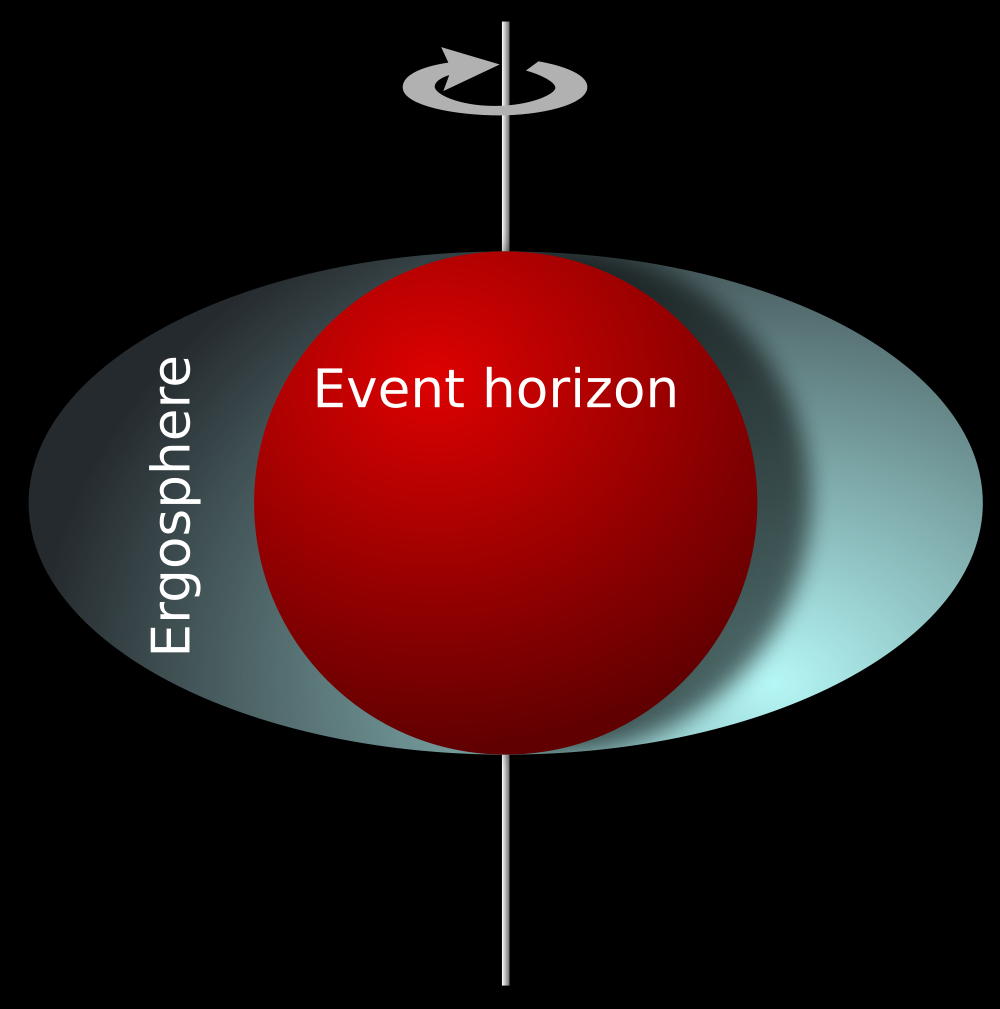
The characteristics of a black hole are its mass, spin (or angular momentum), and electric charge. The latter two of these yield interesting phenomena. When a black hole is spinning, it provides angular momentum to the matter circling it, giving rise to a special region called the ergosphere (see below).


The ergosphere is a region outside the event horizon. Any matter in this region is subjected to not only the gravity of the black hole but also the drag of spacetime itself resulting from the angular momentum of the black hole. Therefore, even though the escape velocity in the region is lower than the speed of light, the sum of this and the additional momentum causes any matter in the region to be moved in the direction of rotation of the black hole. This occurs in such a way that a particle in the ergosphere would have to move at superliminal (over the speed of light) speeds to stay stationary (with respect to an outside frame of reference).

With regard to the electric charge of a black hole, some theories of the universe, notably string theory, acknowledge the possibility of the existence of what is called a magnetic monopole, essentially analogous to "a bar magnet with only one end". Even particles such as electrons, though possessing a net electric charge, have, due to their spin, a typical magnetic dipole called a magnetic moment, which obeys the laws of magnetism. A monopole would have to be composed of some unknown particle, as all elementary particles known to date have magnetic dipole moments. Black holes may be composed of these monopoles, as they are likely to be made of some other elementary particle. Note that these ideas are quantum mechanical. If black holes are true singularities, it may preclude this possibility.

The above are a few exotic phenomena that can arise in black holes. However, returning to the characteristics of the black hole, the three listed above are the only ones known that can be calculated by an outside observer, i.e. by the black hole's effect on its environment. From this viewpoint, one could precisely determine the nature of a black hole with only three parameters. Yet, if an object, say an apple, were to fall into a black hole, there would be no way of knowing afterward that this had occurred! One could record the mass contribution of the apple to the hole, but there is no way of recovering its shape, its color, etc., from observation of the black hole. The information that the apple carried is lost.

Or is it? Many principles of physics are contrary to this assumption. Classical physics and relativity both imply reversibility, that is, they imply that a "simulation" of the universe could be run just as well forward in time or backward. The amount of information in the universe must remain constant, or, in running time backward, one could have no idea of whether an apple, an orange, or any other object of equivalent mass had fallen into the black hole. Furthermore, an important quantum mechanical equation, the wave equation, totally determines of the probabilities of quantum states at any past or future time given the wave equation of a system at the present time. Therefore there can be no "collapse" of many states into one; the scenario with the apple and that with the orange cannot have the same outcome.

Many resolutions to this paradox have been posited. Some state that the information would be conserved in some (initially) non-observable fashion: the information would "leak out" slowly over time as black holes Hawking radiation, or that black holes, at the end of their life, would release all their stored information in a single burst, or even that the information is transported, by means of the singularity through a hole in spacetime, to another universe. However, all three of these violate some aspect of our current understanding of information conservation.

If information leaks out, there is still a time delay in which it is not known. It seems unlikely that all of the information is emitted at the end of a black hole's lifetime, as many theories put a limit on the amount of information that can be stored in a finite volume of space. Finally, if the information is transported to another Universe, the information is not conserved in any local, or obtainable, sense. There is a final alternative, however. It is possible that the fluctuations of the event horizon itself would store the impressions of the incoming (or outgoing) particles. Note that this requires the projection of the information in a four-dimensional space (three spatial dimensions plus time) onto a three-dimensional space (the surface of the event horizon is a two-dimensional surface, which again changes over time), but this poses no problem, and has sound mathematical justification; for a sufficiently "well-behaved function" on a space, the behavior of the function within a region is completely determined by the values of the function on its boundary. This result is known as Green's theorem, and its application to the projection of information onto the event horizon is known as the holographic principle.

Of course, this does not mean we could practically access this information, but simply states that it is, in theory, possible. Other obstacles prevent one from ever reaching the event horizon. One notable phenomenon is relativistic time dilation.


Any massive object creates a depression in space, and a black hole creates an especially steep depression; in fact, if singularities exist as predicted by relativity, the depression would actually be a hole in space, as illustrated above. Due to the symmetry between time and space, again predicted by relativity, time is accordingly distorted near a black hole. If one were to watch another object, or person, approach the event horizon, they would appear to slow down as they neared the edge of the black hole. In fact, from the perspective of an outside observer, they would take infinitely long to cross the horizon itself. From the viewpoint of the object, however, time does not slow, and the crossing of the horizon takes place in finite time.

Of course, no object could actually survive this crossing, but would rather be torn apart by gravitational pull. In addition, no one could actually watch the entire descent, as the radiation that renders one visible, when travelling from the object to the observer, uses energy to move "uphill" in the black hole's gravity field. Lower energy light, for example, is red, so the radiation is said to have red-shifted. By the time an object is close to the horizon, it is only visible in radio waves, and eventually, not at all.

The key concept of degenerate matter is the interplay between gravitation and quantum mechanical forces, in particular how they oppose one another. Black holes, the culmination of the process of stellar collapse, represent the crux of the differences between "large-scale" physical theories, i.e. relativity, and "small-scale" theories, i.e. quantum mechanics. Singularities are present in relativity as "pathological" points in spacetime, where density becomes infinite. However, in light of quantum mechanics, singularities are seem to be contradiction, resulting in exotic phenomena including, but not limited to, those listed above.

Solving the mysteries of degenerate matter and black holes in particular is one of the main outstanding problem in modern physics, and will continue to shape our understanding of the universe for years to come.

Sources: http://astrofacts.files.wordpress.com/2009/07/rouge-black-hole.jpg, No-hair theorem on Wikipedia

Sunday, February 10, 2013

Degenerate Matter: Exotic Stars

This post deals with hypothetical "exotic" stars and their composition. For an introduction to degenerate matter followed by descriptions of its "first two" stages, see here.

Neutron stars, as with white dwarfs, can only exist at a certain range of masses, before gravity overcomes the neutron degeneracy pressure. Above a certain density, neutron degenerate matter can no longer exist.

Here one enters the realm of speculation, as it is not known exactly where this upper limit is, and what stages a degenerate object undergoes immediately after. By most estimates, neutron degenerate matter cannot exist in an object weighing more than 3 solar masses. Since, by the Pauli Exclusion Principle, no two neutrons can occupy the same location at any amount of pressure, it is reasonable to assume that they, under the pressure of gravity, eventually break down instead into their constituent particles: quarks and gluons.

The quark structure of a neutron. The neutron contains two down quarks and one up quark, and connecting particles called gluons (the wavy lines) that bind quarks together.

As the mass of a degenerate object exceeds three solar masses, the matter at the core will collapse from neutron degenerate matter to quark-degenerate matter, better known as quark-gluon plasma. Such an object would then be called a quark star.

Gluons can effectively be ignored in considering the properties of a quark star; since they have a mass of 0, they only contribute in binding quarks into larger particles. In quark stars, however, quarks are free rather than bound in nuclei, and gluons would therefore have little effect.

Therefore, typical (if any such matter can be called "typical") quark-gluon plasma would contain up and down quarks, the lightest and most common quarks. However, at the extremely high densities of a quark star, the energies may be high enough for a third type of quark, the strange quark, to spontaneously form. Strange quarks, the next-heaviest quarks, are not commonly found but, under normal circumstances, decay into up quarks. Strange quarks, however, do compose more exotic particles that have been synthesized in particle accelerators. Quark stars which include strange quarks in their composition are sometimes called strange stars.

At the present time, there is no conclusive evidence in favor of the existence of quark stars, though they have been proposed as an explanation for certain celestial phenomena. For example, there are a few known stellar remnants whose masses have appeared to those of heavy neutron stars (around 2 or 3 solar masses), but whose radii are only 5 miles! Usual neutron stars, with diameters usually twice that figure, are not as dense as these strange objects. As of now, the measurements are not completely certain, and revisions are possible.

Perhaps the most compelling evidence for quark stars are certain types of gamma-ray sources that defy explanation due to their tremendous brightness. One such event was recorded in 2007, and was classified as a supernova, receiving the designation SN 2006gy.


An X-ray image of SN 2006gy (the bright spot in the upper right). The source is 238 million light years away in the galaxy NGC 1260. At its peak, SN 2006gy outshined its entire home galaxy (bright spot in lower left) and was one of the most luminous objects in the universe.

Though initially thought to be a supernova, the explosion released ten times more energy than other similar supernova events. Therefore, some have hypothesized that the event was a so-called quark nova. A quark nova would mark the collapse of a neutron star into a quark star. The transition of the quarks from bound state (in the neutrons) to a free state (quark-gluon plasma or strange matter) would release tremendous amounts of energy: up to a thousand times a "typical" supernova explosion. Another indicator is the concentration of high-energy radiation; SN 2006gy released an unusual amount of radiation in the X-ray and gamma ray areas of the electromagnetic spectrum.

Despite claims of the existence of quark stars, all evidence thus far, including SN 2006gy, is ambiguous and does not confirm nor deny their existence. When a neutron star's gravity overcomes neutron degeneracy pressure and collapses, the resulting stellar remnant does pass through a quark stage, but it is not known whether such a state is stable, or, if it is, what range of masses a quark star can assume. This uncertainty primarily stems from our ignorance of the properties of such super-dense matter.

However, even if quark stars exist, they are only kept stable by quark degeneracy pressure. Quarks, as with neutrons, resist being forced to occupy the same location. But, if the mass exceeds about 3-3.5 solar masses, gravity (theoretically) overcomes quark degeneracy pressure and the stellar remnant collapses. The next step in the life of the collapsed star is, if anything, even more mysterious. One plausible theory is the formation of yet another type of star, termed an electroweak star.

Following the pattern of a neutron star, the quarks in a quark star, when subjected to enough gravitational pressure, break down. However, quarks have no known component particles, so they may instead undergo a decay, related beta decay. The decay only happens in a small area of the core of an electroweak star, and the resulting situation is a striking analog of normal stellar fusion (see below). The use of fuel in this case is called electroweak burning, rather than fusion.


The above diagram is a visualization of a hypothetical electroweak star (not to scale). Such a star, as with a quark star, would probably have an outer layer of neutron degenerate matter, and would appear from the outside as an overdense neutron star. It would probably be on the order of 2-5 miles in diameter, and would have a miniscule core, only the size of an apple! However, packed into this core would be approximately two earth masses. Here, quarks are converted into leptons (including electrons). In the process of this conversion, very small neutrinos (or antineutrinos) are released. The outward pressure provided by these particles stops the electroweak star from collapsing under the force of gravity.

Another curiosity of electroweak stars is the property that gives them their name. At certain extreme temperatures and densities the electromagnetic force (the force which describes the charge of particles, and whose large scale effects are electricity and magnetism) and the weak nuclear force (the force which controls beta decay) "unify". The unification of these forces at extraordinarily high temperatures and densities (on the order of a billion billion degrees, for instance) means that these forces, under such circumstances, are no longer distinguishable and rather behave as manifestations of a single force, called the electroweak force. The center of an electroweak star is one of the only places in the Universe that the conditions necessary for this unification occur. Such conditions notably occurred a trillionth of a second after the Big Bang. Insight into electroweak stars would correspondingly elucidate aspects of the Big Bang.

One might think that such an electroweak star, since it emits a wealth of radiation in the form of neutrinos, would be easily detectable. However, neutrinos are notoriously elusive particles; they hardly interact at all with normal matter, but rather pass right through it. Efforts to detect neutrino sources in the cosmos, therefore, are difficult, and, to this day, only very low-resolution "neutrino-images" have been achieved.

The key parameter in determining how many electroweak stars are out there is stability. Early models seemed to suggest that electroweak burning would only last for a very short time, maybe only a matter of seconds. However, some more recent research has indicated that electroweak stars may have enough fuel to last millions of years or more. In the latter case, there is likely to be a small, but detectable, population of such stars throughout the cosmos.

It is possible, in addition, that electroweak burning would shed enough mass (through neutrinos) from the stellar remnant to render it stable, i.e. supportable by quark degeneracy pressure. However, in other cases, after production of leptons ceases, electroweak stars would collapse further, powerless against gravity, eventually transforming into the most mysterious objects in the universe (see the next post).

Sources: http://www.sciencedaily.com/releases/2008/06/080628224224.htm, Quark Star at Wikipedia, http://news.discovery.com/space/exotic-electroweak-star-predicted.html, http://www.sciencedaily.com/releases/2009/12/091214131132.htm

Saturday, February 2, 2013

Degenerate Matter: Neutron Stars

This post deals with neutron stars and their composition. For an introduction to degenerate matter and the quantum mechanical principles involved, see here. For a description of white dwarfs, the "first" state of degenerate matter, see here.

If only electron degeneracy is taken into account, one would predict that white dwarfs, after reaching a certain threshold, would contract to nothing, the electron degeneracy pressure not being enough to hold of the force of gravity, partly due to relativistic effects. However, this is not the case. For stars that leave stellar remnants in excess of 1.44 solar masses, the rapid shrinking of the core under the force of gravity that occurs after fusion ceases forms a new type of object: a neutron star.

In a neutron star, the nucleons (protons and neutrons) are pushed into such close proximity that the Pauli Exclusion Principle comes into play, forcing the particles involved to stay separate and not assume the same quantum state. Neutrons, being much more massive than electrons, produce less degeneracy pressure at the same density than electrons do, as it takes more energy to cause them to move at the same speeds. Therefore, a neutron star is much denser, and therefore smaller, than a white dwarf. These remarkable bodies are less than 10 miles in radius!

Neutron stars have many interesting properties, since they are among the densest forms of matter. First, they are in many ways similar to a giant atomic nucleus, but containing trillions and trillions instead of merely hundreds of nucleon; the two entities are quite comparable in density, however-each packs approximately 300,000,000,000,000,000 (3*1017) kilograms into each cubic meter. If the entire mass of the Earth were compressed to this density, it would occupy a volume roughly equivalent to that of the Great Pyramid of Giza! An object on the surface of a neutron star would have to achieve a velocity one-third of the speed of light to escape its gravity, and any matter that falls onto a neutron star impacts with such force that the atoms themselves are broken apart.

Another interesting phenomenon arising from the strong gravity of neutron stars is gravitational lensing. The light emitted from the surface of a neutron star, though having sufficient velocity to escape its gravitational pull, is distorted and curved back towards the surface. As a result, when looking at a neutron star from any given side, one can see more than half of the surface (illustrated below).

A diagram indicating the portion of the surface visible looking at a neutron star with the equator head-on. 
Each patch covers 30° by 30° of surface. The poles are visible as the points of convergence of the longitude lines. Note that, without distortion, one could only see up to the poles, but on a neutron star, one can see more than 40° beyond each pole and around the far side.

In addition, neutron stars rotate. The force of rotation of a parent star is conserved when it becomes a neutron star, but since a neutron star is many times smaller, the momentum causes it to spin extremely rapidly: usually completing each rotation in less than a second! This causes many neutron stars to have a "bulge" near the equatorial regions.

Another important property of a neutron star is its magnetic field. The magnetic field of a neutron star is on the order of a billion times stronger than Earth's, and in some cases it is over a trillion times stronger. Young neutron stars, at high temperatures, emit large amounts of electromagnetic radiation. The structure of the magnetic field causes these beams of energy to be released at the poles. Neutron stars with these electromagnetic beams are called pulsars. Pulsars can be easily detected when one of the poles faces Earth at some time during the neutron star's rotation.

A combined optical, and X-ray image of the Vela pulsar. A distinct beam of radiation in evident from its north pole.
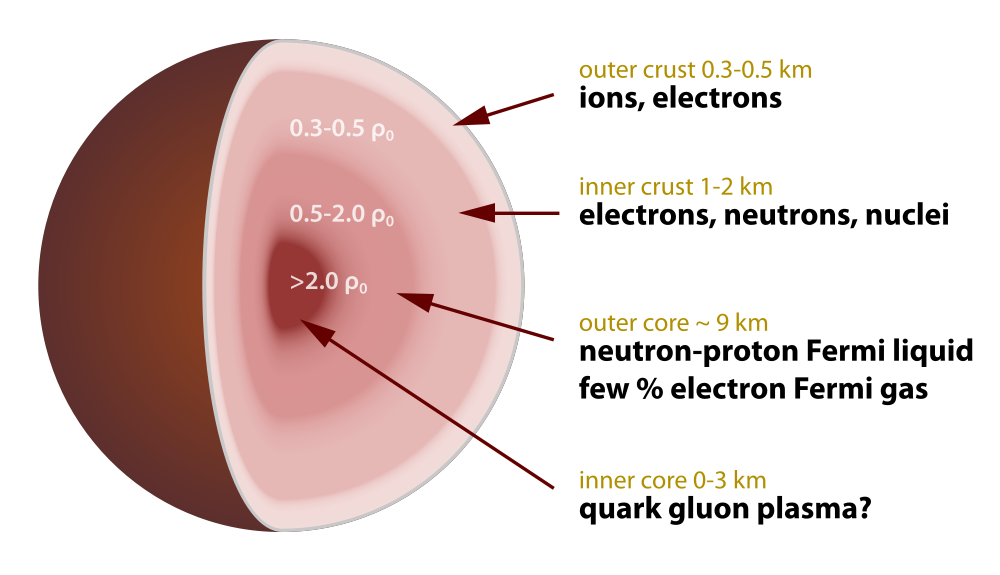
The composition of neutron stars is not definitively known, and various types of matter appear between the outer crust and the center of a neutron star, as the density of the object increases significantly as one journeys inward.

A hypothetical cross-section of a neutron star, based on many simulations and models.
The densities are in terms of the constant ρ0, the density at which isolated protons and neutrons actually touch one another.  The crust generally consists of atomic nuclei, whose valence electrons have been pushed out by the extreme pressures. The electrons themselves float freely, creating an "electron sea" around the nuclei. This makes the matter of the crust extremely conductive. A similar phenomenon actually occurs in regular metals, with free-flowing electrons surrounding ions. Metals are therefore by some definitions electron degenerate! However, they are not degenerate for the same reason as stellar remnants, as the metals obviously are not (usually) at extraordinarily high densities.

Proceeding inward, one reaches the outer core. Here, the high density causes electrons and protons to become neutrons through a reverse of beta decay, called electron capture. Therefore, the nuclei of the outer core are very neutron rich, to the extent that they would not be stable under normal conditions. Only the density of the neutron star keeps such neutron-rich nuclei together. As one penetrates farther into the outer core, however, neutrons begin to "drip" out of nuclei and become free-flowing, as even the tremendous pressure is not enough to hold together the neutron-rich nuclei.

Near the core, as the pressure exceeds ρ0, neutrons come into physical contact. Being fermions, the Pauli Exclusion Principle (which states that no two fermions can have the same quantum state, that is, occupy the same location simultaneously) causes pressure counteracting the force of gravity. In a manner similar to the situation in white dwarfs, this counterpressure is known as neutron degeneracy pressure.

It is not known what type of matter exists at the very center of a neutron star, and the answer may vary with the neutron star's mass. However, matter consisting completely of neutrons by definition "should" compose the inner core of a neutron star (by its name), and if, as displayed above, other exotic types of matter exist there, the object would more appropriately be called a "quark star". Such hypothetical objects, their composition, and observational evidence for them, are discussed in the next post.

Sources: http://en.wikipedia.org/wiki/Neutron_star, http://en.wikipedia.org/wiki/Degenerate_matter#Neutron_degeneracy, http://www.astro.umd.edu/~miller/nstar.html

Friday, January 25, 2013

Degenerate Matter: White Dwarfs

This post deals with white dwarfs and their composition. For an introduction to Degenerate Matter, see here.

Stellar remnants, which no longer produce the huge amounts of energy necessary to counteract the compressive force of gravity, succumb to it. A star becomes a stellar remnant when nuclear fusion, and therefore energy output, ceases. At what point this occurs depends on the size of the star.

For the smallest stars, fusion ends when all of the hydrogen is consumed and converted into helium.

The composition of a low-mass star.

The core has become rich in helium after the completion of hydrogen fusion. When the outer layers are shed, a so-called white dwarf of pure helium remains. It is estimated that, for stars with less than .5 solar masses, this type of white dwarf is the eventual fate. Such stars, during their lifetime, never achieve the temperature necessary (100 million Kelvin) to form elements heavier than helium. However, such small stars also burn their hydrogen fuel very slowly, so such a star would have a lifetime greater than 13.7 billion years, the current age of the Universe. As such, none of this type of dwarf should be found in the Universe. Despite this, some have been observed, and it is proposed that such objects form when another body sucks the outer hydrogen layers from a low-mass star, making it too small to continue fusion and abruptly ending its lifetime.

However, a slightly heavier star, such as our Sun, is able to fuse helium near the end of its life, forming heavier elements such as carbon and oxygen. The white dwarf that will be the end stage of our Sun's lifetime will be composed mainly of these elements.

The size of a white dwarf also depends on its mass, but not in the expected fashion. More massive white dwarfs actually have smaller radii. To be more precise, the cube of the radius varies inversely with the mass, or, for some proportionality constant k, R3 = k/M.

A mass-radius diagram for a white dwarf (click to enlarge).

A Fermi gas is a gas composed of particles that exert degeneracy pressure. The name distinguishes it from an ideal gas; models assuming gases to be ideal ignore particle size and atomic forces. In the case of a white dwarf, the electrons exert the degeneracy pressure, and they are the particles of the Fermi gas. The curve labeled "Non-relativistic Fermi gas" models the inverse cube law that relates the mass and radius. A typical white dwarf (from the mass-radius chart), therefore has a density hundreds of thousands of times greater than that of Earth.

At first, it is nearly coincident with the actual variation, that modeled by relativity (the green curve). The gradual, and then rapid, disassociation of these curves stems from the velocity of the electrons. By Heisenburg's uncertainty principle, the velocity of the electrons that cause the degeneracy pressure increases as the radius of the white dwarf decreases, due to the increased certainty of position. However, as the speed of the electrons approaches c, the speed of light, the theory of relativity predicts that their mass will actually increase. This, from a relativistic frame of reference, augments the mass of the white dwarf and causes it to contract further before stabilizing due to increased degeneracy pressure.

However, this can only continue up to a certain point before the relativistic model would spiral out of control: the added degeneracy pressure caused by the contraction of the white dwarf would not be enough to combat the increased velocity, and therefore mass, of the electrons. The contraction would then be self-reinforcing, and the radius would shrink to zero, as illustrated on the graph.

Therefore, there is an upper limit on white dwarf mass, known as the Chandrasekhar Mass Limit (marked CM on the diagram), equal to about 1.44 solar masses. Some white dwarfs have been observed as being more massive, but this may be due to another factor: spin. If a white dwarf is rotating, the centrifugal force is added to the degeneracy pressure to combat the force of gravity. Theoretically, a rapid spin could allow a white dwarf to even exceed 2 solar masses.

Such an event is somewhat rare though, and in the case of a parent star over 8 solar masses, the remnant is usually too massive to become a white dwarf. In this event, however, the stellar remnant does not simply contract to nothing; it becomes another type of degenerate matter, which will be discussed in the next post.

Sources: White Dwarf at Wikipedia, http://spiff.rit.edu/classes/phys230/lectures/planneb/planneb.html, http://imagine.gsfc.nasa.gov/docs/science/know_l2/dwarfs.html

Thursday, January 17, 2013

Degenerate Matter: Introduction

Degenerate matter, simply speaking, is matter at very high densities. Environments where such matter exists are relatively rare throughout the Universe, and they most commonly occur in the cores of stars, or stellar remnants.

Formally, ordinary matter assumes a "degenerate" state when atoms are packed in such close proximity that the very structure of atoms, and eventually, their constituent particles, breaks down. This happens in stages, and at each stage, there is a different type of degenerate matter.

Two major quantum mechanical principles come into play in determining the nature of degenerate matter. The first is the Heisenberg Uncertainty Principle. It states that there are certain pairs of properties of a particle has that can only be simultaneously known to a certain accuracy. In the context of degenerate matter, the pair of position and momentum is the most important. Therefore, as the position of a particle is known with greater and greater accuracy, the momentum is more and more uncertain, and vice versa. The principle is represented by the equation below.


In this equation, ∆χ is the error in the position, and ∆ρ is the error in momentum. The right side of the equation is simply a constant, specifically the reduced Planck Constant divided by 2. The product of the two errors is always greater than this value. It is clear that, if ∆χ is reduced, ∆ρ will increase, and vice versa.

The second principle of quantum mechanics necessary for an analysis of degenerate matter is the Pauli Exclusion Principle. This principle establishes that no two identical particles can be in the same quantum state simultaneously, i.e. have the same quantum numbers. Since these numbers can take only specific values, one particle literally "excludes" another from having the same properties. The most well-known example of this is the principle's application to elections, which defines the structure of the atom.


The above is a visualization of the electron structure of the element Xenon. For each electron shell, i.e. each concentric ring in the above image, the Pauli Exclusion Principle precludes "stuffing in" any more electrons beyond full capacity. The first three shells here have a capacity of 2, 8, and 18 electrons respectively, all of which are filled; no more electrons could fit within them, and the rest therefore had to next occupy the fourth and fifth shells. The key idea is that electron states are discrete; only a finite number of electrons can fill a certain level. There is also a minimum energy level, below which no electron can exist.

Armed with these ideas, one can now understand how degeneracy comes about. Consider a gas under normal conditions stored in a container (below).


The individual particles (molecules or atoms) have varying momenta, with some moving faster, and some slower, but the average speed of all the particles in the container can easily be found. It is commonly known as the temperature of the gas. Also, the gas produces a pressure pushing on the container, created when particles bounce off all sides. This pressure is practically uniform, due to the minuteness of the particles involved, and is called the thermal pressure. This pressure is what keeps a balloon inflated, for example.

Clearly, this thermal pressure varies with temperature. When the temperature is increased, the particles involved are more energetic, move faster, and therefore exert a higher pressure on the sides of the container. Similarly, if one shrinks the container, more particles will bounce off the sides of the container per unit time, and consequently, the pressure on the container will increase. Therefore, pressure on the container is proportional to the temperature of the gas and inversely proportional to the space which it occupies. These phenomena are part of the kinetic theory of gases, and are summarized in the equation below:

p = kt/s

where p is pressure on the container, t is temperature, s is size of the container, and k is the associated proportionality constant, which varies from gas to gas.

By the above theory, when the temperature of a gas is lowered, the size would have be lowered correspondingly to keep the pressure constant. If the temperature were lowered to absolute zero, however, the particles of the gas would no longer be in motion, and no pressure would be exerted on the sides of the container no matter how small it was. The gas could then be compressed into an arbitrarily small volume with no resistance.

However, this does not occur, as the kinetic theory of gases in an approximation, and does not take quantum phenomena into account. When the electrons associated with particles of gas are put into a very small space, their positions are easily measured, and almost precisely pinpointed. Returning to the Heisenburg Uncertainty Principle, this implies that to compensate for the very low uncertainty in position, there must be a high uncertainty in momentum, meaning that the electrons must have very high velocities despite a temperature of near absolute zero.

Note that this principle does not dictate that a particular electron is suddenly imparted with a higher momentum, but merely states that, on average, the uncertainty must increase, and there therefore are some electrons traveling faster. At the same time, many electrons are being pushed into the same space as the container is compressed, and, by the Pauli Exclusion Principle, cannot occupy the same quantum state. They are then pushed into higher energy states, generally producing an outward force.

The combination of these two effects produces an intense pressure against further compression not predicted by the kinetic theory. This is known as electron degeneracy pressure. When more of the counter-force pushing outward on the container is supplied by electron degeneracy pressure than by thermal pressure, then the matter involved is known as electron-degenerate.

To find a naturally occurring example of electron-degenerate matter, one must look no further than the night sky, see the next post.


Sources: http://publicdomainclip-art.blogspot.com/2010/04/werner-heisenberg-uncertainty-principle.html, webelements.com, http://spiff.rit.edu/classes/phys230/lectures/planneb/planneb.html,