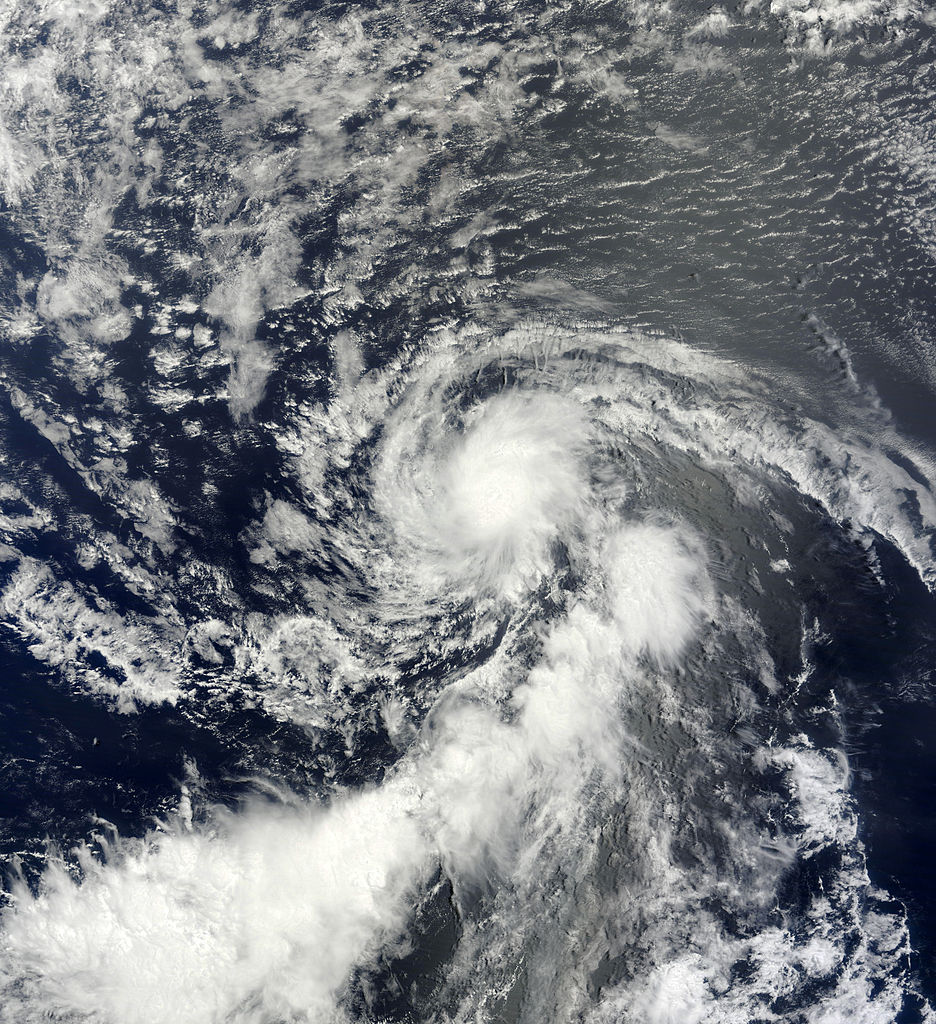
Storm Active: September 6-7
A tropical wave in the northwestern Caribbean Sea began to exhibit scattered shower activity on September 2. However, on September 3, the system moved over the Yucatan Peninsula, which temporarily stifled development. By September 5, the wave had reemerged into the Bay of Campeche and acquired a low pressure center, around which more concentrated convection appeared. By this time, the system had turned west-southwest towards Mexico, where land would quickly dissipate the system. However, the disturbance stalled just off the coast during the afternoon of September 6, giving it just enough time to develop sufficient organization and banding features to be classified as Tropical Depression Eight.
A few hours later, the depression made landfall in Mexico, bringing 3-5 inches of rain over a large swath of land over the next couple days. However, by early on September 7, Eight's circulation had lost definition to the point that it was downgraded to a remnant low. By late that day, the remnant low had dissipated over southern Mexico.
Tropical Depression Eight was a very short-lived system which attained tropical status just hours before landfall. The above image shows Eight mere minutes before landfall in Mexico.
Eight spent only 14.5 hours as a tropical cyclone.
Friday, September 6, 2013
Thursday, September 5, 2013
Tropical Storm Gabrielle (2013)
Storm Active: September 4-5, 10-13
On August 26, a tropical wave formed near the coast of Africa and moved westward. Shower activity associated with the system remained minimal due to an unfavorable upper atmosphere for most of the next week. However, by August 31, a broad low pressure center had formed along the wave, and convection increased somewhat, though still remaining disorganized. On September 1, shower and thunderstorm activity associated with the disturbance spread over the islands forming the eastern edge of the Caribbean. Meanwhile, another tropical wave formed a few hundred miles east of the existing system, and the two systems began to interact, forming a widespread area of convective activity stretching from the eastern Caribbean well into the central Atlantic.
Wind shear declined significantly as the first low entered the Caribbean, but the system still struggled with a good deal of dry air aloft for the next few days as it remained nearly stationary in the far eastern Caribbean. On September 3, the low assumed a more northwesterly track, and more concentrated cloud cover appeared in the vicinity of the low pressure center, though the center itself remained poorly defined. However, on September 4, hurricane hunter aircraft investigating the system found a circulation organized enough to merit the low's classification as Tropical Depression Seven.
Partially due to the influence of the tropical wave still churning to its northeast, Seven continued to the northwest toward western Puerto Rico that evening. Small increases in outflow definition and a deepening of convection prompted the upgrade of Seven to Tropical Storm Gabrielle overnight. However, during the morning of September 6, it became clear that the surface circulation of Gabrielle had become decoupled from the mid-level atmospheric center by over 100 miles: the surface circulation was still approaching the channel between Puerto Rico and Hispaniola but the mid-level center and all the associated swirl in satellite imagery was displaced well to the northeast due to upper-level winds. This separation caused the system to quickly weaken into a tropical depression, and since a new surface low did not form in alignment with the structure of the upper-atmosphere, Gabrielle dissipated that evening. Heavy rains continued throughout the northeastern Caribbean due to the remnants of Gabrielle and still because of the lingering disturbance to the northeast over the next day.
The two systems finally combined as the remnants of Gabrielle moved north-northeastward, but the low-pressure center formerly associated with the tropical storm remained intact, and in fact moved into slightly more favorable conditions. On September 9, the low deepened and deep convection appeared near and to the east of its center. By early on September 10, the system had regenerated into Tropical Storm Gabrielle. Meanwhile, an upper-level low situated north of Bermuda altered the bearing of the tropical storm, pushing it in a more northerly direction toward Bermuda.
During that afternoon, Gabrielle became more organized despite experiencing shear out of the west and southwest, and quickly reached a peak intensity of 60 mph winds and a pressure of 1004 mb as it passed within 25 miles of Bermuda, bringing tropical storm force winds and heavy rainfall. However, shortly after Gabrielle reached this intensity, the southwesterly shear displaced the convection associated with the system to the east, exposing the center. This trend caused weakening into September 11. Meanwhile, the upper-level low north of Gabrielle had caused the cyclone to veer left further, and it was now bearing northwest at a slower forward speed. The circulation became almost totally void of convection that evening and Gabrielle weakened to a tropical depression but the cyclone recovered somewhat during the morning of September 12 as shear decreased.
This prompted the upgrade of the system back to a tropical storm that day. Gabrielle also began to accelerate northward and north-northeastward as it entered the flow of an approaching frontal system that evening. By early on September 13, the cyclone had once again weakened to a tropical depression as the associated convection lost its banding features and began to interact with an approaching front. Finally, later that day, the system lost its closed circulation and dissipated. The moisture from Gabrielle contributed to rainfall in Atlantic Canada the next day.
The above image shows Gabrielle shorting after reforming on September 10.
The track of Gabrielle took it very close to Bermuda at its peak intensity, causing some heavy rainfall and gusty winds.
On August 26, a tropical wave formed near the coast of Africa and moved westward. Shower activity associated with the system remained minimal due to an unfavorable upper atmosphere for most of the next week. However, by August 31, a broad low pressure center had formed along the wave, and convection increased somewhat, though still remaining disorganized. On September 1, shower and thunderstorm activity associated with the disturbance spread over the islands forming the eastern edge of the Caribbean. Meanwhile, another tropical wave formed a few hundred miles east of the existing system, and the two systems began to interact, forming a widespread area of convective activity stretching from the eastern Caribbean well into the central Atlantic.
Wind shear declined significantly as the first low entered the Caribbean, but the system still struggled with a good deal of dry air aloft for the next few days as it remained nearly stationary in the far eastern Caribbean. On September 3, the low assumed a more northwesterly track, and more concentrated cloud cover appeared in the vicinity of the low pressure center, though the center itself remained poorly defined. However, on September 4, hurricane hunter aircraft investigating the system found a circulation organized enough to merit the low's classification as Tropical Depression Seven.
Partially due to the influence of the tropical wave still churning to its northeast, Seven continued to the northwest toward western Puerto Rico that evening. Small increases in outflow definition and a deepening of convection prompted the upgrade of Seven to Tropical Storm Gabrielle overnight. However, during the morning of September 6, it became clear that the surface circulation of Gabrielle had become decoupled from the mid-level atmospheric center by over 100 miles: the surface circulation was still approaching the channel between Puerto Rico and Hispaniola but the mid-level center and all the associated swirl in satellite imagery was displaced well to the northeast due to upper-level winds. This separation caused the system to quickly weaken into a tropical depression, and since a new surface low did not form in alignment with the structure of the upper-atmosphere, Gabrielle dissipated that evening. Heavy rains continued throughout the northeastern Caribbean due to the remnants of Gabrielle and still because of the lingering disturbance to the northeast over the next day.
The two systems finally combined as the remnants of Gabrielle moved north-northeastward, but the low-pressure center formerly associated with the tropical storm remained intact, and in fact moved into slightly more favorable conditions. On September 9, the low deepened and deep convection appeared near and to the east of its center. By early on September 10, the system had regenerated into Tropical Storm Gabrielle. Meanwhile, an upper-level low situated north of Bermuda altered the bearing of the tropical storm, pushing it in a more northerly direction toward Bermuda.
During that afternoon, Gabrielle became more organized despite experiencing shear out of the west and southwest, and quickly reached a peak intensity of 60 mph winds and a pressure of 1004 mb as it passed within 25 miles of Bermuda, bringing tropical storm force winds and heavy rainfall. However, shortly after Gabrielle reached this intensity, the southwesterly shear displaced the convection associated with the system to the east, exposing the center. This trend caused weakening into September 11. Meanwhile, the upper-level low north of Gabrielle had caused the cyclone to veer left further, and it was now bearing northwest at a slower forward speed. The circulation became almost totally void of convection that evening and Gabrielle weakened to a tropical depression but the cyclone recovered somewhat during the morning of September 12 as shear decreased.
This prompted the upgrade of the system back to a tropical storm that day. Gabrielle also began to accelerate northward and north-northeastward as it entered the flow of an approaching frontal system that evening. By early on September 13, the cyclone had once again weakened to a tropical depression as the associated convection lost its banding features and began to interact with an approaching front. Finally, later that day, the system lost its closed circulation and dissipated. The moisture from Gabrielle contributed to rainfall in Atlantic Canada the next day.
The above image shows Gabrielle shorting after reforming on September 10.
The track of Gabrielle took it very close to Bermuda at its peak intensity, causing some heavy rainfall and gusty winds.
Labels:
2013 Storms
Monday, August 26, 2013
Tropical Storm Fernand (2013)
Storm Active: August 25-26
On August 23, thunderstorm activity increased markedly in association with a tropical wave situated over the western Caribbean sea, just east of the Yucatan Peninsula. Over the next day, the system brought significant rainfall to the peninsula and to other parts of Central America as it moved west-northwestward. Late on August 24, a low pressure center was identified along the tropical wave, and despite still being over land, the disturbance became more organized.
The low emerged into the Bay of Campeche on August 25, allowing the warm ocean water to fuel the development of convection near the center of circulation. By the afternoon, the convection had developed prominent banding features, meriting the upgrade of the disturbance into Tropical Depression Six. As the cyclone formed, it was already in a stage of rapid development, and aircraft data indicated that Six had strengthened into Tropical Storm Fernand just two hours after its initial designation. In addition, however, the same data suggested that the center had reformed farther south, and the track adjustment reduced Fernand's time over open water. Therefore, even as a concentrated inner core of very cold cloud tops developed, bringing Fernand to its peak intensity of 50 mph winds and a pressure of 1001 mb, the tropical storm swiftly made landfall in Mexico very early on August 26. By late that afternoon, Fernand had dissipated.
In the above image, Tropical Storm Fernand was in the midst of rapid development, though this process was quelled almost immediately by interaction with land.
Fernand was a very short-lived system, persisting as a tropical cyclone for little over a day.
On August 23, thunderstorm activity increased markedly in association with a tropical wave situated over the western Caribbean sea, just east of the Yucatan Peninsula. Over the next day, the system brought significant rainfall to the peninsula and to other parts of Central America as it moved west-northwestward. Late on August 24, a low pressure center was identified along the tropical wave, and despite still being over land, the disturbance became more organized.
The low emerged into the Bay of Campeche on August 25, allowing the warm ocean water to fuel the development of convection near the center of circulation. By the afternoon, the convection had developed prominent banding features, meriting the upgrade of the disturbance into Tropical Depression Six. As the cyclone formed, it was already in a stage of rapid development, and aircraft data indicated that Six had strengthened into Tropical Storm Fernand just two hours after its initial designation. In addition, however, the same data suggested that the center had reformed farther south, and the track adjustment reduced Fernand's time over open water. Therefore, even as a concentrated inner core of very cold cloud tops developed, bringing Fernand to its peak intensity of 50 mph winds and a pressure of 1001 mb, the tropical storm swiftly made landfall in Mexico very early on August 26. By late that afternoon, Fernand had dissipated.
In the above image, Tropical Storm Fernand was in the midst of rapid development, though this process was quelled almost immediately by interaction with land.
Fernand was a very short-lived system, persisting as a tropical cyclone for little over a day.
Labels:
2013 Storms
Thursday, August 15, 2013
Tropical Storm Erin (2013)
Storm Active: August 14-18
A strong tropical wave and associated low pressure system moved off of the African coast on August 13 and immediately began to organize. The next day, convection concentrated near the center as the system began to pass south of the Cape Verde Islands, bringing showers and some windy conditions. By the evening of August 14, the disturbance was sufficiently organized to be classified as Tropical Depression Five. At first, the highest winds were not situated over the center of circulation, but organization continued as the system tracked west-northwest, and by the morning of August 15, Five had strengthened into Tropical Storm Erin.
During that day, Erin was already struggling with the atmospheric dry air still present in that region of the Atlantic, fluctuating between periods of strong convection and nearly none at all. Meanwhile the cyclone turned slightly toward the northwest into a weakness in a ridge to its north, and entered a region of somewhat cooler waters. On August 16, wind shear out of the southwest increased also, driving convection off to the east of Erin's center, and the system was downgraded to a tropical depression. Late that night, however, a burst of convection reappeared, and satellite data suggested that Erin had restrengthened into a tropical storm.
Erin's new status was not to last, though, as the hostile conditions again tore away the cloud cover over the system's center of circulation on August 17. By that evening, the center also showed signs of elongation, and Erin was again downgraded to a tropical depression. The cyclone continued to degenerate on August 18, and became a remnant low that afternoon. The remnant low dissipated over the open Atlantic by August 20.
The image above shows Erin shortly after being named. The cyclone achieved only minimal tropical storm status.
A weakness in the subtropical ridge to its north allowed Erin to move northwestward into cooler water and very hostile atmospheric conditions. These conditions promptly dissipated the system.
A strong tropical wave and associated low pressure system moved off of the African coast on August 13 and immediately began to organize. The next day, convection concentrated near the center as the system began to pass south of the Cape Verde Islands, bringing showers and some windy conditions. By the evening of August 14, the disturbance was sufficiently organized to be classified as Tropical Depression Five. At first, the highest winds were not situated over the center of circulation, but organization continued as the system tracked west-northwest, and by the morning of August 15, Five had strengthened into Tropical Storm Erin.
During that day, Erin was already struggling with the atmospheric dry air still present in that region of the Atlantic, fluctuating between periods of strong convection and nearly none at all. Meanwhile the cyclone turned slightly toward the northwest into a weakness in a ridge to its north, and entered a region of somewhat cooler waters. On August 16, wind shear out of the southwest increased also, driving convection off to the east of Erin's center, and the system was downgraded to a tropical depression. Late that night, however, a burst of convection reappeared, and satellite data suggested that Erin had restrengthened into a tropical storm.
Erin's new status was not to last, though, as the hostile conditions again tore away the cloud cover over the system's center of circulation on August 17. By that evening, the center also showed signs of elongation, and Erin was again downgraded to a tropical depression. The cyclone continued to degenerate on August 18, and became a remnant low that afternoon. The remnant low dissipated over the open Atlantic by August 20.
The image above shows Erin shortly after being named. The cyclone achieved only minimal tropical storm status.
A weakness in the subtropical ridge to its north allowed Erin to move northwestward into cooler water and very hostile atmospheric conditions. These conditions promptly dissipated the system.
Labels:
2013 Storms
Thursday, July 25, 2013
Tropical Storm Dorian (2013)
Storm Active: July 24-27, August 3
On July 22, a tropical wave emerged off of the African coast centered around 12°N latitude. The wave was the strongest yet for the 2013 Atlantic hurricane season, and begin to organize almost immediately. By July 23, rotation was evident in the satellite presentation, and convection had become more concentrated about the newly-formed low pressure center. Later that day, the disturbance passed south of the Cape Verde Islands, bringing some scattered showers to the southernmost islands. The definition of the circulation improved further during the evening and thunderstorm activity persisted, so the low was upgraded to Tropical Depression Four early on July 24.
Later that morning, as the system moved west-northwest, it organized further, and strengthened into Tropical Storm Dorian. The storm was entering less favorable conditions, including the slightly cooler water of the central Atlantic and a large dry air mass to the northwest, but the effect of these factors was partially neutralized by a warm, moist air flow that continued into Dorian from the south. Over the next day, therefore, the tropical storm was still able to improve in outflow and convective organization, allowing it to intensify into a strong tropical storm by early on July 25.
Late that day, a large burst of convection flared up, and Dorian even exhibited a clouded eye briefly, reaching its peak intensity of 60 mph winds and a pressure of 999 mb. However, even though the system was now moving into warmer waters, it lost its equatorial inflow of moist air, and the circulation was largely at the mercy of the large dry air mass to its west. This dry air, coupled with moderate shear out of the southwest, disrupted the circulation during the evening of July 25, and Dorian became much less organized. The storm weakened into July 26, and meanwhile continued to race west-northwest, as a ridge to its north steered the shallower circulation faster than it had the previous day, when Dorian had been stronger.
Later that day, Dorian made a turn more toward the west and moved even faster. The circulation became totally exposed that evening as nearly all convection disappeared from the system. It was unclear whether Dorian was still a tropical system overnight, but some thunderstorm activity did redevelop during the early morning hours of July 27, prompting the National Hurricane Center to continue issuing advisories on the weak tropical storm. However, the wind shear had now increased to such a degree that it was eroding the circulation, and it became clear during the afternoon of the same day that Dorian's circulation was no longer closed and that it had degenerated into a tropical wave.
The remnants of Dorain continued west-northwestward and continued to produce gale force winds and convection. However, though a swirl in the clouds was evident, this was not due to a closed surface circulation, but to an upper-level low in association with the system. Thus, despite the fact that the disturbance was no longer a tropical cyclone, the north coasts of Puerto Rico and Hispaniola experienced high surf as the system continued to move west-northwestward. The moisture that had been part of Dorian began to spread over the Bahamas on July 31, and conditions improved as shear lessened. On August 1, more convection appeared and surface pressures fell near the western Bahamas during that day.
By August 2, a trough of low pressure was evident, but the system did not yet have a closed circulation. As the western edge of the system brushed Florida, the remnants of Dorian triggered showers and thunderstorms over various parts of the state. However, the low turned northward that day, navigating around the edge of the Bermuda High. Overnight, despite the fact that upper-level winds were again increasing, a closed circulation appeared, indicating that Dorian had reformed into a tropical depression. By the morning of August 3, convection was displaced well southwest of the center of circulation. But Dorian persisted after its reformation for only 12 hours, reaching only tropical depression intensity and degenerating into a remnant low by the afternoon. The low was absorbed by a frontal boundary the next day.
Dorian was afflicted by dry air for most of its lifetime. The above image shows the western half of the circulation to be partially exposed due to the same dry air, even though Dorian is near its peak intensity.
Before reforming on August 3, Dorian had for a time been only a tropical wave, with no associated low pressure center.
On July 22, a tropical wave emerged off of the African coast centered around 12°N latitude. The wave was the strongest yet for the 2013 Atlantic hurricane season, and begin to organize almost immediately. By July 23, rotation was evident in the satellite presentation, and convection had become more concentrated about the newly-formed low pressure center. Later that day, the disturbance passed south of the Cape Verde Islands, bringing some scattered showers to the southernmost islands. The definition of the circulation improved further during the evening and thunderstorm activity persisted, so the low was upgraded to Tropical Depression Four early on July 24.
Later that morning, as the system moved west-northwest, it organized further, and strengthened into Tropical Storm Dorian. The storm was entering less favorable conditions, including the slightly cooler water of the central Atlantic and a large dry air mass to the northwest, but the effect of these factors was partially neutralized by a warm, moist air flow that continued into Dorian from the south. Over the next day, therefore, the tropical storm was still able to improve in outflow and convective organization, allowing it to intensify into a strong tropical storm by early on July 25.
Late that day, a large burst of convection flared up, and Dorian even exhibited a clouded eye briefly, reaching its peak intensity of 60 mph winds and a pressure of 999 mb. However, even though the system was now moving into warmer waters, it lost its equatorial inflow of moist air, and the circulation was largely at the mercy of the large dry air mass to its west. This dry air, coupled with moderate shear out of the southwest, disrupted the circulation during the evening of July 25, and Dorian became much less organized. The storm weakened into July 26, and meanwhile continued to race west-northwest, as a ridge to its north steered the shallower circulation faster than it had the previous day, when Dorian had been stronger.
Later that day, Dorian made a turn more toward the west and moved even faster. The circulation became totally exposed that evening as nearly all convection disappeared from the system. It was unclear whether Dorian was still a tropical system overnight, but some thunderstorm activity did redevelop during the early morning hours of July 27, prompting the National Hurricane Center to continue issuing advisories on the weak tropical storm. However, the wind shear had now increased to such a degree that it was eroding the circulation, and it became clear during the afternoon of the same day that Dorian's circulation was no longer closed and that it had degenerated into a tropical wave.
The remnants of Dorain continued west-northwestward and continued to produce gale force winds and convection. However, though a swirl in the clouds was evident, this was not due to a closed surface circulation, but to an upper-level low in association with the system. Thus, despite the fact that the disturbance was no longer a tropical cyclone, the north coasts of Puerto Rico and Hispaniola experienced high surf as the system continued to move west-northwestward. The moisture that had been part of Dorian began to spread over the Bahamas on July 31, and conditions improved as shear lessened. On August 1, more convection appeared and surface pressures fell near the western Bahamas during that day.
By August 2, a trough of low pressure was evident, but the system did not yet have a closed circulation. As the western edge of the system brushed Florida, the remnants of Dorian triggered showers and thunderstorms over various parts of the state. However, the low turned northward that day, navigating around the edge of the Bermuda High. Overnight, despite the fact that upper-level winds were again increasing, a closed circulation appeared, indicating that Dorian had reformed into a tropical depression. By the morning of August 3, convection was displaced well southwest of the center of circulation. But Dorian persisted after its reformation for only 12 hours, reaching only tropical depression intensity and degenerating into a remnant low by the afternoon. The low was absorbed by a frontal boundary the next day.
Dorian was afflicted by dry air for most of its lifetime. The above image shows the western half of the circulation to be partially exposed due to the same dry air, even though Dorian is near its peak intensity.
Before reforming on August 3, Dorian had for a time been only a tropical wave, with no associated low pressure center.
Labels:
2013 Storms
Monday, July 8, 2013
Tropical Storm Chantal (2013)
Storm Active: July 7-10
During the first days of July, a tropical wave moved off of the coast of Africa and tracked rapidly westward. By July 5, concentrated thunderstorms had appeared in a association with a low pressure area at the southern tip of the tropical wave as it moved through the central Atlantic. Initially, development was not anticipated due to the timing: in early July, the central Atlantic does not often support tropical development, partially due to Saharan dry air dominating the region. However, the system remained exceptionally far south, between 5° and 10°N latitude, and it was isolated from the strong shear to its north.
On July 7, satellite data indicated the imminent development of a closed circulation in association with the wave as the low pressure system gained definition. Late that evening, the low was designated Tropical Storm Chantal, as it was observed to have tropical storm force winds. At the time, Chantal was tracking rapidly westward, at speeds in excess of 25 mph, embedded as it was in strong steering winds. During the day of July 8, Chantal's winds steadily increased and its circulation became better defined, but the convective organization remained quite ragged as strong subtropical ridges continued to steer the storm west to west-northwest.
On July 9, showers and thunderstorms began to impact the Windward Islands as the cyclone passed through. Bursts of thunderstorm activity flared up periodically throughout the day, and Chantal continued its trend of modest strengthening, managing to maintain its circulation despite its forward velocity. The system reached its peak intensity of 65 mph winds and a pressure of 1005 mb. However, that evening, increasing westerly shear finally began to take its toll, decoupling the tropical storm's circulation from the surrounding shower activity. By late that evening, nearly all convection had vanished, and the center was nearly impossible to identify.
While it appeared as though Chantal had lost its circulation entirely and degenerated into a tropical wave, rapid development of thunderstorm activity occurred during the morning of July 10 and a poorly defined circulation was found. The system also had made a turn back to the west, indicating a shallow circulation. Indeed, the pressure had risen and Chantal had weakened to a low-end tropical storm. However, heavy rain, mostly displaced to the north and east of the center, swept over much of Hispaniola that afternoon as the storm passed to the south. Finally, additional evidence emerged during the evening of the same day that the circulation had indeed disappeared, and advisories were discontinued as Chantal degenerated into a tropical wave.
A low pressure trough associated with the remnants of Chantal was still producing a large area of thunderstorms on July 11 as it drifted northwestward over eastern Cuba and into the Bahamas. Over the following two days, the disturbance continued to cause rainfall in the Bahamas, and eventually in parts of the U.S. southeast coast, but it did not show any signs of development, and on July 13 merged with a larger system to its north.
The above image shows Chantal, not at peak intensity, but perhaps at peak convective organization before it entered the Caribbean.
Chantal moved at a blistering pace before dissipating in the Caribbean. The final points on the track (triangles) show its progress as a disturbance over Hispaniola and Cuba, where it caused widespread flooding.
During the first days of July, a tropical wave moved off of the coast of Africa and tracked rapidly westward. By July 5, concentrated thunderstorms had appeared in a association with a low pressure area at the southern tip of the tropical wave as it moved through the central Atlantic. Initially, development was not anticipated due to the timing: in early July, the central Atlantic does not often support tropical development, partially due to Saharan dry air dominating the region. However, the system remained exceptionally far south, between 5° and 10°N latitude, and it was isolated from the strong shear to its north.
On July 7, satellite data indicated the imminent development of a closed circulation in association with the wave as the low pressure system gained definition. Late that evening, the low was designated Tropical Storm Chantal, as it was observed to have tropical storm force winds. At the time, Chantal was tracking rapidly westward, at speeds in excess of 25 mph, embedded as it was in strong steering winds. During the day of July 8, Chantal's winds steadily increased and its circulation became better defined, but the convective organization remained quite ragged as strong subtropical ridges continued to steer the storm west to west-northwest.
On July 9, showers and thunderstorms began to impact the Windward Islands as the cyclone passed through. Bursts of thunderstorm activity flared up periodically throughout the day, and Chantal continued its trend of modest strengthening, managing to maintain its circulation despite its forward velocity. The system reached its peak intensity of 65 mph winds and a pressure of 1005 mb. However, that evening, increasing westerly shear finally began to take its toll, decoupling the tropical storm's circulation from the surrounding shower activity. By late that evening, nearly all convection had vanished, and the center was nearly impossible to identify.
While it appeared as though Chantal had lost its circulation entirely and degenerated into a tropical wave, rapid development of thunderstorm activity occurred during the morning of July 10 and a poorly defined circulation was found. The system also had made a turn back to the west, indicating a shallow circulation. Indeed, the pressure had risen and Chantal had weakened to a low-end tropical storm. However, heavy rain, mostly displaced to the north and east of the center, swept over much of Hispaniola that afternoon as the storm passed to the south. Finally, additional evidence emerged during the evening of the same day that the circulation had indeed disappeared, and advisories were discontinued as Chantal degenerated into a tropical wave.
A low pressure trough associated with the remnants of Chantal was still producing a large area of thunderstorms on July 11 as it drifted northwestward over eastern Cuba and into the Bahamas. Over the following two days, the disturbance continued to cause rainfall in the Bahamas, and eventually in parts of the U.S. southeast coast, but it did not show any signs of development, and on July 13 merged with a larger system to its north.
The above image shows Chantal, not at peak intensity, but perhaps at peak convective organization before it entered the Caribbean.
Chantal moved at a blistering pace before dissipating in the Caribbean. The final points on the track (triangles) show its progress as a disturbance over Hispaniola and Cuba, where it caused widespread flooding.
Labels:
2013 Storms
Monday, June 17, 2013
Tropical Storm Barry (2013)
Storm Active: June 17-20
A tropical wave located off the eastern coast of Nicaragua began to show signs of organization on June 15. On June 16, a swirling of clouds became evident on satellite imagery, though a surface circulation had not yet formed and, in any case, the proximity of the developing circulation to central America limited thunderstorm activity.
However, the disturbance emerged into the northwest Caribbean on June 17, and late that morning, a low-level circulation appeared and the system was upgraded to Tropical Depression Two only 60 miles east of the coast of Belize. Later that day, the depression made landfall in Belize at an intensity of 35 mph winds and a pressure of 1008 mb, bringing heavy rainfall to the region.
The depression weakened over land, and lost definition, but the system continued to move west-northwest, and the northern half of the circulation regained convection as the northwestern portion emerged into the Bay of Campeche early on June 18. A ridge situated over the northern Gulf of Mexico weakened slightly that day, allowing the cyclone to shift north slightly in its path. As a result, the center entered the Bay of Campeche during the afternoon of that day, and thunderstorm activity soon recovered near the center.
Though moderate wind shear still affected the depression out of the southwest, the shear began to weaken during the morning of June 19, as the system made a turn westward toward the Mexican coast. This allowed the thunderstorm activity to increase markedly, and the depression was upgraded to Tropical Storm Barry that afternoon. The system continued to gain organization through the early morning of June 20, reaching its peak intensity of 45 mph winds and a pressure of 1003 mb before making its final landfall in Mexico later that morning.
The system quickly weakened over land, becoming a tropical depression that evening, and degenerating into a remnant low late that night. Barry main effect was heavy rainfall; the tropical storm dumped several inches of rain over a large swath of southern Mexico, with localized totals-especially in mountainous regions-exceeding 5 inches.
Tropical Storm Barry achieved its peak intensity as a weak tropical storm shortly before its second landfall in Mexico.
A combination of a slow forward speed and extensive moisture from the Bay of Campeche made Barry a significant flooding threat near the end of its life.
A tropical wave located off the eastern coast of Nicaragua began to show signs of organization on June 15. On June 16, a swirling of clouds became evident on satellite imagery, though a surface circulation had not yet formed and, in any case, the proximity of the developing circulation to central America limited thunderstorm activity.
However, the disturbance emerged into the northwest Caribbean on June 17, and late that morning, a low-level circulation appeared and the system was upgraded to Tropical Depression Two only 60 miles east of the coast of Belize. Later that day, the depression made landfall in Belize at an intensity of 35 mph winds and a pressure of 1008 mb, bringing heavy rainfall to the region.
The depression weakened over land, and lost definition, but the system continued to move west-northwest, and the northern half of the circulation regained convection as the northwestern portion emerged into the Bay of Campeche early on June 18. A ridge situated over the northern Gulf of Mexico weakened slightly that day, allowing the cyclone to shift north slightly in its path. As a result, the center entered the Bay of Campeche during the afternoon of that day, and thunderstorm activity soon recovered near the center.
Though moderate wind shear still affected the depression out of the southwest, the shear began to weaken during the morning of June 19, as the system made a turn westward toward the Mexican coast. This allowed the thunderstorm activity to increase markedly, and the depression was upgraded to Tropical Storm Barry that afternoon. The system continued to gain organization through the early morning of June 20, reaching its peak intensity of 45 mph winds and a pressure of 1003 mb before making its final landfall in Mexico later that morning.
The system quickly weakened over land, becoming a tropical depression that evening, and degenerating into a remnant low late that night. Barry main effect was heavy rainfall; the tropical storm dumped several inches of rain over a large swath of southern Mexico, with localized totals-especially in mountainous regions-exceeding 5 inches.
Tropical Storm Barry achieved its peak intensity as a weak tropical storm shortly before its second landfall in Mexico.
A combination of a slow forward speed and extensive moisture from the Bay of Campeche made Barry a significant flooding threat near the end of its life.
Labels:
2013 Storms
Thursday, June 6, 2013
Tropical Storm Andrea (2013)
Storm Active: June 5-7
On June 2, scattered shower activity associated with a trough situated near the eastern coast of the Yucatan Peninsula begin to organize. The system moved north-northwest, and despite only marginally favorable conditions, partially stemming from frontal boundaries moving through the north Gulf of Mexico, developed further. Surface pressures declined near the center of the disturbance during the day of June 4, but the circulation remained broad, and all convection was displaced to the east of the forming center by wind shear in the western Gulf. On June 5, conditions became briefly favorable for formation as the disturbance moved northward, and an aircraft investigating the system found that a well-defined center had formed. The system was therefore named Tropical Storm Andrea, the first tropical cyclone of the 2013 season.
By the early hours of June 6, Andrea was already accelerating north-northeast in the wake of a trough lifting out of the southeast United States. The structure of the cyclone already exhibited some extratropical properties, as its convection was still displaced generally to the north of the center, and a band southeast of the center, reminiscent of a frontal boundary, was forming. Despite this, the circulation deepened and Andrea underwent modest strengthening during that day.
Torrential rains had already begun over Florida and parts of South Carolina that afternoon as the northern bands of Andrea's circulation interacted with a frontal system moving towards the east coast. The system made landfall in northwestern Florida at its peak intensity of 65 mph winds and a pressure of 993 mb at 5:45 pm that evening. The system accelerated considerably and weakened quickly over land overnight as the circulation broadened and dry air invaded the center of circulation early on June 7. By that afternoon, the cyclone was declared post-tropical.
As the cyclone moved northeastward, it caused significant rainfall across the mid-Atlantic and towards New England as the center of circulation stayed near the coastline. The remnants of Andrea dumped a few inches of rain across a large swath of this region in conjunction with the frontal system steering it. By the afternoon of June 8, the cyclone had lifted out of New England.

Tropical Storm Andrea reached peak intensity shortly before making landfall in Florida.

Andrea tracked up the U.S. east coast, largely as a post-tropical cyclone, and brought heavy rainfall to many areas.
On June 2, scattered shower activity associated with a trough situated near the eastern coast of the Yucatan Peninsula begin to organize. The system moved north-northwest, and despite only marginally favorable conditions, partially stemming from frontal boundaries moving through the north Gulf of Mexico, developed further. Surface pressures declined near the center of the disturbance during the day of June 4, but the circulation remained broad, and all convection was displaced to the east of the forming center by wind shear in the western Gulf. On June 5, conditions became briefly favorable for formation as the disturbance moved northward, and an aircraft investigating the system found that a well-defined center had formed. The system was therefore named Tropical Storm Andrea, the first tropical cyclone of the 2013 season.
By the early hours of June 6, Andrea was already accelerating north-northeast in the wake of a trough lifting out of the southeast United States. The structure of the cyclone already exhibited some extratropical properties, as its convection was still displaced generally to the north of the center, and a band southeast of the center, reminiscent of a frontal boundary, was forming. Despite this, the circulation deepened and Andrea underwent modest strengthening during that day.
Torrential rains had already begun over Florida and parts of South Carolina that afternoon as the northern bands of Andrea's circulation interacted with a frontal system moving towards the east coast. The system made landfall in northwestern Florida at its peak intensity of 65 mph winds and a pressure of 993 mb at 5:45 pm that evening. The system accelerated considerably and weakened quickly over land overnight as the circulation broadened and dry air invaded the center of circulation early on June 7. By that afternoon, the cyclone was declared post-tropical.
As the cyclone moved northeastward, it caused significant rainfall across the mid-Atlantic and towards New England as the center of circulation stayed near the coastline. The remnants of Andrea dumped a few inches of rain across a large swath of this region in conjunction with the frontal system steering it. By the afternoon of June 8, the cyclone had lifted out of New England.
Tropical Storm Andrea reached peak intensity shortly before making landfall in Florida.
Andrea tracked up the U.S. east coast, largely as a post-tropical cyclone, and brought heavy rainfall to many areas.
Labels:
2013 Storms
Wednesday, May 22, 2013
Professor Quibb's Picks-2013
My personal prediction for the 2013 Atlantic hurricane season is (written May 20, 2013):
18 cyclones attaining tropical depression status
16 cyclones attaining tropical storm status
9 cyclones attaining hurricane status
4 cyclones attaining major hurricane status
These predictions are slightly above normal for an Atlantic hurricane season, particularly in the hurricanes category.
The last decade or so has constituted by far the most active such period in known history for tropical cyclone formation. This may reflect a long-term cycle in Atlantic tropical cyclone activity, known as the Atlantic Multidecadal Oscillation (AMO). The AMO could theoretically explain, for example, the lull in formation in the 1980's and the recent surge in the 2000's.
However, the state of the El Nino is fairly neutral. It is fairly unlikely that a strong El Nino or La Nina event will develop significantly before the conclusion of this year's hurricane season. A neutral state of the ENSO would suggest a fairly average season. This reasoning, coupled with the fact that the Altantic basin is still in a long-term active period, suggests a slightly above above normal hurricane season.
Finally, sea surface temperatures near the U.S., especially near the Gulf Coast, are below normal, and well below where they were in May 2012, partially stemming from a much colder winter and early spring across several areas of the country. Favorable conditions may then be slow to reach areas near the U.S., though this of course does not exclude powerful mid- or late-season storms.
Below, my anticipated risk factors for four major regions of the Atlantic basin are listed. The risk index runs from 1 meaning very low potential to 5 being very high potential.
U.S. East Coast: 3
Though the Bermuda High is still far to the east, near the Azores, small blocking ridges may be frequent in the western Atlantic, so tropical cyclones could very well be steered towards the east coast. Again, such an event is unlikely towards the beginning of the season due to cooler waters and anomalously high wind shear, but the risk near the end of the season is higher.
U.S. Gulf Coast/Northern Mexico: 2
The Gulf of Mexico has not only been anomalously cool, but also the jet stream has dipped well into the U.S. Midwest over the first few months of this year. Such events cause disturbed weather to be frequent, but generally inhibit cyclone formation. As such, the Gulf coasts of U.S. and Mexico are relatively protected, though there is still potential for a sufficiently powerful cyclone to track through the Gulf and make landfall. Also, Florida is at an above average risk, despite the low Gulf index overall.
Yucatan Peninsula and Central America: 3
As usual, the Yucatan and surrounding areas can expect some tropical cyclone activity, particularly in the form of weak systems. The eastern Atlantic is warm and conditions will be favorable for the development of tropical waves before such waves enter the southwestern Caribbean, so stronger storms will almost certainly track to the north.
Caribbean Islands: 5
It has been a few years since a "traditional" Cape Verde hurricane has formed in the east Atlantic and stayed on a westerly path over the Caribbean Islands. However, the likely development of temporary ridges over the tropical Atlantic would push even strong hurricanes on such a path. The strongest cyclones of the season are likely to come over, or pass close to, these islands.
Overall, a slightly above average 2013 season is expected, with particular risk to the Caribbean Islands and the southeast U.S.. Since the climate of the Atlantic region is less volatile than last year, there may be fewer meandering storms such as Hurricane Nadine, and fewer unusual jet stream interactions, such as the one which caused Hurricane Sandy to make landfall in the northeast.
18 cyclones attaining tropical depression status
16 cyclones attaining tropical storm status
9 cyclones attaining hurricane status
4 cyclones attaining major hurricane status
These predictions are slightly above normal for an Atlantic hurricane season, particularly in the hurricanes category.
The last decade or so has constituted by far the most active such period in known history for tropical cyclone formation. This may reflect a long-term cycle in Atlantic tropical cyclone activity, known as the Atlantic Multidecadal Oscillation (AMO). The AMO could theoretically explain, for example, the lull in formation in the 1980's and the recent surge in the 2000's.
However, the state of the El Nino is fairly neutral. It is fairly unlikely that a strong El Nino or La Nina event will develop significantly before the conclusion of this year's hurricane season. A neutral state of the ENSO would suggest a fairly average season. This reasoning, coupled with the fact that the Altantic basin is still in a long-term active period, suggests a slightly above above normal hurricane season.
Finally, sea surface temperatures near the U.S., especially near the Gulf Coast, are below normal, and well below where they were in May 2012, partially stemming from a much colder winter and early spring across several areas of the country. Favorable conditions may then be slow to reach areas near the U.S., though this of course does not exclude powerful mid- or late-season storms.
Below, my anticipated risk factors for four major regions of the Atlantic basin are listed. The risk index runs from 1 meaning very low potential to 5 being very high potential.
U.S. East Coast: 3
Though the Bermuda High is still far to the east, near the Azores, small blocking ridges may be frequent in the western Atlantic, so tropical cyclones could very well be steered towards the east coast. Again, such an event is unlikely towards the beginning of the season due to cooler waters and anomalously high wind shear, but the risk near the end of the season is higher.
U.S. Gulf Coast/Northern Mexico: 2
The Gulf of Mexico has not only been anomalously cool, but also the jet stream has dipped well into the U.S. Midwest over the first few months of this year. Such events cause disturbed weather to be frequent, but generally inhibit cyclone formation. As such, the Gulf coasts of U.S. and Mexico are relatively protected, though there is still potential for a sufficiently powerful cyclone to track through the Gulf and make landfall. Also, Florida is at an above average risk, despite the low Gulf index overall.
Yucatan Peninsula and Central America: 3
As usual, the Yucatan and surrounding areas can expect some tropical cyclone activity, particularly in the form of weak systems. The eastern Atlantic is warm and conditions will be favorable for the development of tropical waves before such waves enter the southwestern Caribbean, so stronger storms will almost certainly track to the north.
Caribbean Islands: 5
It has been a few years since a "traditional" Cape Verde hurricane has formed in the east Atlantic and stayed on a westerly path over the Caribbean Islands. However, the likely development of temporary ridges over the tropical Atlantic would push even strong hurricanes on such a path. The strongest cyclones of the season are likely to come over, or pass close to, these islands.
Overall, a slightly above average 2013 season is expected, with particular risk to the Caribbean Islands and the southeast U.S.. Since the climate of the Atlantic region is less volatile than last year, there may be fewer meandering storms such as Hurricane Nadine, and fewer unusual jet stream interactions, such as the one which caused Hurricane Sandy to make landfall in the northeast.
Labels:
Hurricane Stats
Thursday, May 16, 2013
Hurricane Names List-2013
For the North Atlantic Basin, the hurricane names list for 2013 is as follows:
Andrea (used)
Barry (used)
Chantal (used)
Dorian (used)
Erin (used)
Fernand (used)
Gabrielle (used)
Humberto (used)
Ingrid (used)
Jerry (used)
Karen (used)
Lorenzo (used)
Melissa (used)
Nestor
Olga
Pablo
Rebekah
Sebastien
Tanya
Van
Wendy
This list is the same as that of the 2007 Atlantic Hurricane Season, except for the addition of Dorian, Fernand, and Nestor, to replaced retired hurricanes Dean, Felix, and Noel, respectively.
Andrea (used)
Barry (used)
Chantal (used)
Dorian (used)
Erin (used)
Fernand (used)
Gabrielle (used)
Humberto (used)
Ingrid (used)
Jerry (used)
Karen (used)
Lorenzo (used)
Melissa (used)
Nestor
Olga
Pablo
Rebekah
Sebastien
Tanya
Van
Wendy
This list is the same as that of the 2007 Atlantic Hurricane Season, except for the addition of Dorian, Fernand, and Nestor, to replaced retired hurricanes Dean, Felix, and Noel, respectively.
Labels:
Hurricane Stats
Subscribe to:
Posts (Atom)